
Cartridges
TIJ 2.5 cartridge model cross-reference
If the label in your hand reads 2588, 2580, B9F16A or IQ800, this page tells you which of those numbers describe the same object and which only describe a different supplier. TIJ 2.5 and HP45 name one format, and the numbers are not the product.
One format, several hundred numbers
Every cartridge in these tables sits on the same 300-nozzle thermal platform. HP sold the format as the HP45; the trade now calls the same body TIJ 2.5. One printhead, one 42 ml ink chamber and one filter are sealed into a single part that you replace whole.
The numbers multiplied for commercial reasons rather than technical ones. A filler who puts the same body on the market under a house label creates a number, and so does a distributor with a private SKU. The result is a catalogue where a dozen genuinely different inks wear forty different names.
So this page separates the two questions that a model list always mixes: what the format fixes for every cartridge, and what only the ink decides.
What the format fixes, whatever the number says
These twelve values hold for any TIJ 2.5 cartridge, whether the label reads 2588, JS12 or XM-45S. They are properties of the platform, and they come from published HP 51645A data rather than from our own bench.
| Item | Value on the platform | Note |
|---|---|---|
| Print technology | TIJ 2.5 thermal inkjet (HP45 format) | Printhead, ink chamber and filter sealed as one part |
| Nozzles | 300, in a single row | 1/300 in nozzle spacing |
| Native resolution | 300 dpi | The platform value |
| Maximum resolution | up to 600 dpi | Print-mode dependent; 300 × 300 and 300 × 600 are common |
| Print width | 12.7 mm (half-inch) or 25.4 mm (one-inch) | Head width becomes character height |
| Nominal capacity | 42 ml | One fill across the platform |
| Drop volume | about 29–38 pl | Varies by model and print mode |
| Fire frequency | 12–18 kHz | Varies by ink and drive settings |
| Drop placement | ±0.1 mm | Platform figure |
| Throw distance | 1–2 mm optimum, about 5 mm maximum | Placement degrades with distance |
| Operating environment | 15–35 °C, 35–80% relative humidity, non-condensing | Same for every model |
| Colour | Decided by the ink | Six colours plus invisible UV in circulation |
Four things are missing on purpose: drying time, adhesion, rub resistance and decap. They follow the ink formulation, so they belong to one model’s datasheet rather than to the platform. Our own cartridge publishes drying of typically 1–5 s on non-porous surfaces, and asks you to confirm decap for the ink you choose.
The first decision is width, before any number
12.7 mm · half-inch
Half-inch: one line of data
A date, a batch, a serial or a specification code. Handheld and mini printers are built around this width, and it is the lighter, faster-changing option on a busy line.
Handheld printers at 12.7 mm →25.4 mm · one-inch
One-inch: multi-line, 2D codes, logos
This body needs a carriage tall enough to take it. Two heads butted together go wider still, which is how a 50 mm block gets printed in one pass.
Handheld printers at 25.4 mm →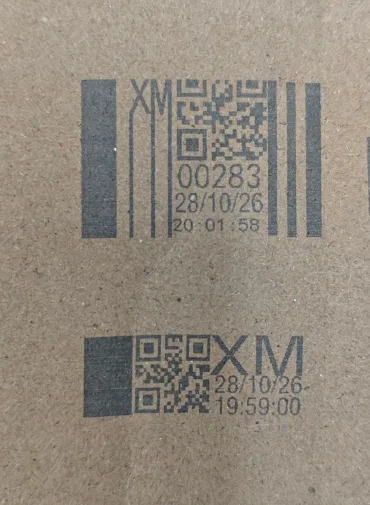
Why the model list looks chaotic
Three things happened at once. Each one added a number without adding a product, and together they are why the list looks chaotic.
- 01
One platform, many labels
The same body leaves different factories under different numbers. A filler’s own number, a distributor’s number and a customer’s private label can all point at one cartridge, and none of them is wrong.
- 02
Original, alternate and house numbers are mixed together
On this platform only HP’s own part numbers are original. Most numbers in circulation are alternates: B9F16A, 300S, 2588 and FOL13B all belong to that group. House numbers such as JS10 or JS12 sit on top of them. The tables below keep the three apart.
- 03
The difference is the ink and the chip, not the number
A number tells you whether the body fits a carriage. It cannot tell you whether the ink will hold on your material. Capacity is fixed at 42 ml across the platform, so what is left to vary is formulation and chip version.
Solvent and oil-based fast-dry numbers
Start here when the print has to hold on coated film, plastic, metal or glass. The numbers narrow the shortlist; the printer and a trial decide the rest.
| Number | Ink direction | Common print width | What the number usually means |
|---|---|---|---|
| 45si / 45A | Solvent 45si / water 45A | 12.7 mm | HP’s own number; the platform reference point |
| B3F58A / B3F58B | Solvent, fast-dry | 12.7 mm | Grouped with the 2580; A and B differ, read the label |
| F0L89B / F0L91A | Solvent | 12.7 mm | Often swapped with the B3F58 pair; the printer decides |
| 2580 | Mild solvent, high adhesion | 12.7 / 25.4 mm | High-adhesion end: metal, glass, PET, coated film |
| 2586 / 2586K | Solvent | 12.7 mm | Common on handheld and inline printers |
| 2588 | Oil-based, fast-dry | 12.7 mm | Workhorse: PE bags, cartons, general packaging |
| 2588M / 2588K | Oil-based, fast-dry | 12.7 mm | Same family as 2588; ink or chip revision differs |
| 2589 | Solvent | 12.7 mm | Appears in the same lists as the 2588 |
| 2590 | Solvent | 12.7 mm | Corresponds to the original number W3T10B |
| FOL13B / F0L13B | Solvent | 12.7 mm | A 2588-compatible number; F0 and FO are the same |
| JS10 / JS12 / JS12M | Oil-based, fast-dry | 12.7 mm | House numbers, common on handheld and small inline units |
| 1704K / 2706K / 2790K | Solvent | 12.7 mm | High resolution: fine text, logos, 2D codes |
| 2560 / 2570 | Solvent | 12.7 mm | Paired with earlier models; confirm on the label |
Compiled from public trade information. Two suppliers can fill one number with different inks, so treat colour and formulation as unconfirmed until you have read the physical label.
Alternate numbers that carry a colour code
This batch is numbered differently: the code after the number is the colour, and one number can hang under five of them.
B9F16A, B9F26A, 300S, 308S, 300av2 and 308av2 are alternate numbers rather than HP original parts. They are how individual suppliers describe a body and an ink on this platform, and they are the majority of what circulates.
BK is black, while BLUE, Magenta, GREEN and Yellow name themselves. The lesson sits in the ordering, not the reading: two cartridges that share a number and differ in colour are two different products, and a bare B9F16A identifies neither of them.
| Number | Print width | Ink direction | Colour | Typical use |
|---|---|---|---|---|
| B9F16A (BK) | 12.7 mm | Solvent, fast-dry | Black | Non-porous: plastic, film, metal, glass |
| B9F16A (BLUE) | 12.7 mm | Solvent, fast-dry | Blue | Non-porous: plastic, film, metal, glass |
| B9F16A (Magenta) | 12.7 mm | Solvent, fast-dry | Magenta | Non-porous: plastic, film, metal, glass |
| B9F16A (GREEN) | 12.7 mm | Solvent, fast-dry | Green | Non-porous: plastic, film, metal, glass |
| B9F16A (Yellow) | 12.7 mm | Solvent, fast-dry | Yellow | Non-porous: plastic, film, metal, glass |
| 300S E300 (BK) | 12.7 mm | Solvent, super-black | Super-black | Super-black: contrast on dark material |
| 300S B8F (BK) | 12.7 mm | Solvent | Black | Non-porous: plastic, film, metal, glass |
| 300S TBSW | 12.7 mm | Solvent | White | White: reads on dark cable, plastic, board |
| 300av2 TPG1 (BK) | 12.7 mm | Water-based, pigment | Black | Porous: carton, paper, wood |
| B9F26A | 25.4 mm | Solvent | Black | One-inch: multi-line, 2D code, logo |
| B9F26A (Yellow) | 25.4 mm | Solvent, fast-dry | Yellow | One-inch: multi-line, 2D code, logo |
| 308S TWSW | 25.4 mm | Pigment, fast-dry | White | One-inch white: reads on a dark substrate |
| 308av2 QPD1 (BK) | 25.4 mm | Water-based pigment, fast-dry | Black | One-inch water-based: carton, paper |
The codes after the number — E300, B8F, TBSW, TWSW, QPD1, TPG1 — look like each supplier’s own ink codes. What they stand for is that supplier’s business, so ask for their label and datasheet. Fill is 42 ml across all of them.
- Quote the number and the colour together. A bare B9F16A cannot be picked or priced.
- A number shaped like an HP part does not make an original part. On a printer that enforces a chip, the chip decides whether the cartridge runs at all.
Water-based numbers
For carton, paper and wood, where the surface absorbs. Adhesion is rarely the problem and the ink costs less, so the first question is simply whether your material takes water.
| Number | Ink direction | Common print width | What the number usually means |
|---|---|---|---|
| 45A | Water-based, pigment | 12.7 mm | Single and multi-line text on carton, paper |
| 2510 / F0L95A | Water-based, pigment | 12.7 mm | Single and multi-line text on carton, paper |
| 2520 / F0L69A | Water-based | 12.7 mm | Confirm colour and formulation on the physical label |
| 2242 | Water-based | 12.7 mm | Confirm colour and formulation on the physical label |
| 4500 | Water-based | 12.7 mm | Confirm colour and formulation on the physical label |
| 1918 / 2531 | Water-based, dye | 12.7 mm | Confirm colour and formulation on the physical label |
Water-based fills are also 42 ml. Where a table entry says to confirm on the label, that is because the number is used for more than one colour or formulation in the market.
- One number can be sold with a chip and without one. A printer that expects a handshake will not run the unchipped version, however correct the body is.
- Mixing ink brands inside one printer puts the head at risk. Pick one ink and stay with it.
One supplier’s own line: the IQ and HD numbers
The tables above are trade numbers that many companies share. This one is different, because it belongs to a single company: the product line of General Co., Ltd, transcribed from their public English catalogue on 21 October 2026. If the cartridge in your hand carries one of these numbers, the table is here so that you can identify it.
- These are that company’s numbers, not ours, and they are not HP original parts either. Their catalogue describes the inks as formulated in-house on HP bodies.
- Identification only. We do not reproduce their per-ink performance claims, because a claim about adhesion or drying on someone else’s line says nothing about the material in front of you.
- Same platform, not the same formulation. The 42 ml fill and the 12.7 or 25.4 mm width carry across; adhesion, drying and rub resistance do not.
Solvent (17)
| Model | Ink direction | Colour | Colorant | Stated shelf life |
|---|---|---|---|---|
| IQ797MAX | Solvent | Black | Dye | 12 months |
| IQ890 | Solvent | Black | Dye | 12 months |
| IQ880 | Solvent | Black | Dye | 12 months |
| IQ797Plus | Solvent | Black | Dye | 12 months |
| IQ800Plus | Solvent | Black | Dye | 8 months |
| IQ800 | Solvent | Black | Dye | 9 months |
| IQ990 | Solvent | Black | Dye | 6 months |
| IQ801 | Solvent | Black | Dye | 9 months |
| IQ-HH | Solvent | Black | Dye | 12 months |
| IQ-LH | Solvent | Black | Dye | 12 months |
| IQ798Plus | Solvent | Red | Dye | 12 months |
| IQ799 | Solvent | Blue | Dye | 6 months |
| IQ314Plus | Solvent | White | Pigment | 12 months |
| IQ324S | Solvent | Yellow | Pigment | 6 months |
| IQ334S | Solvent | Light blue | Pigment | 6 months |
| IQ248S | Solvent | Clear → Red under UV | Dye | 9 months |
| IQ249S | Solvent | Clear → Blue under UV | Dye | 9 months |
Water-based (7)
| Model | Ink direction | Colour | Colorant | Stated shelf life |
|---|---|---|---|---|
| HD156 | Water-based | Black | Dye | 12 months |
| HD119 | Water-based | Black | Dye + pigment | 12 months |
| HD119LD | Water-based | Black | Dye + pigment | 12 months |
| IQ2392A | Water-based | Black | Pigment | 12 months |
| HD120 | Water-based | Blue | Dye + pigment | 12 months |
| HD157 | Water-based | Green | Dye | 12 months |
| HD158 | Water-based | Red | Dye | 12 months |
UV LED curing (9)
We do not supply UV-curable inks. This group is listed so that a cartridge you already own can be identified, not as something we can quote against.
| Model | Ink direction | Colour | Colorant | Stated shelf life |
|---|---|---|---|---|
| IQ128 | UV LED curing | Black | Pigment | 5 months |
| IQ430 | UV LED curing | Black | Pigment | 5 months |
| IQ431 | UV LED curing | White | Pigment | 5 months |
| IQ131C | UV LED curing | Light blue | Pigment | 5 months |
| IQ433 | UV LED curing | Clear | Not stated | 5 months |
| IQ134CW | UV LED curing | Clear → White under UV | Not stated | 5 months |
| IQ134CY | UV LED curing | Clear → Yellow under UV | Pigment | 5 months |
| IQ134CM | UV LED curing | Clear → Magenta under UV | Pigment | 5 months |
| IQ134CC | UV LED curing | Clear → Cyan under UV | Pigment | 5 months |
One column is deliberately absent: the catalogue’s feature description for each ink. Those are that company’s own assessment of its own range. Reprinting them here would dress an unverified claim up as a specification, so ask them for it or trial the ink.
Source: General Co., Ltd, English product catalogue, transcribed 21 October 2026. Model names, colours, colorants and shelf lives are as published there. Their catalogue states neither print width nor fill volume, so neither is given; the platform values are 12.7 or 25.4 mm and 42 ml.
Four criteria that beat any number
A number answers whether the body fits. These four answer whether the result is worth shipping.
Print width
Half-inch covers a date, a batch or a serial. Multi-line text, a 2D code or a logo needs the one-inch body, and wider content is built by butting heads together.
Ink direction, decided by the material
Porous material takes water-based ink; coated film, plastic, metal and glass need solvent or mild solvent. Get this wrong and the correct number still fails, which is why the material question comes before the model question.
Consumption and reorder rhythm
42 ml is a constant, not a selection criterion. What needs planning is your reorder rhythm: take ink in batches, so that nothing reaches its shelf life while it waits.
Chip: enforced or open
One number exists in a chipped and an unchipped version. If your printer insists on a handshake, the open version will not run. Confirming this needs the printer brand and model, not the cartridge alone.
Where these figures come from
Platform figures
Nozzle count, resolution, print width, drop volume and throw distance come from HP’s published 51645A data, cross-checked against TIJ 2.5 documentation in circulation. They are format characteristics, so they hold across models.
What does not transfer
That data describes a desktop-era consumer cartridge. Industrial TIJ 2.5 uses the same head platform with entirely different inks. Drying time, adhesion, rub resistance and decap are ink properties: read them from the model’s own datasheet, never from the platform table.
How to use a number safely
Treat every number on this page as a candidate rather than an answer. Send the printer brand and model, a photo of the label on the cartridge you run now, the material, and what the code has to survive. We check platform and chip, and where the answer is still unclear we send a sample before you commit.
On third-party catalogues
The third-party section exists to translate a label and nothing more. A shared platform is not a shared formulation, and no number on any list makes an ink suitable for your line. Only a trial on your own material does that.
Questions that come with a model number
Can a B9F16A or B9F26A replace a 2588?
Only if the body, the chip and the ink all line up, and the first of those rules one of them out: B9F26A is a one-inch body, while the 2588 is half-inch, so it is not a substitute at all. B9F16A can share a carriage with a 2588 on some printers, but the ink behind each number is chosen by its supplier rather than by the number. Send the printer model and we will tell you which of the three has to be checked.
I run IQ800 cartridges from General. Can you supply an equivalent?
We can tell you what IQ800 is, because the catalogue lists it as a solvent black on the standard body. What we cannot tell you is that ours equals theirs, because nobody has measured that on your material. Our published range is a mild-solvent and a solvent fast-dry cartridge in six colours, so ask for a sample against your printer instead of an equivalence claim.
Are 2588, 2580 and 2589 the same cartridge?
No. They share a body and a 42 ml fill, and they are sold with different inks. The 2580 sits at the high-adhesion, mild-solvent end, the 2588 is the oil-based fast-dry workhorse for packaging, and the 2589 is usually solvent. A filler may treat any of them differently again, which is why the number alone cannot settle it.
Why do you not publish full specifications for every number?
Because for most of them we would be inventing the numbers. We publish specifications for the cartridges we make, taken from our own production and testing. For a number we do not make, the honest entries are the ink direction and the width. Anything beyond that would be copied from a catalogue we cannot verify.
Is a claim of 800,000 characters from a 42 ml cartridge credible?
Character yield depends on how many dots each character needs, not on ink volume alone. A single-line 5 × 7 code at 12.7 mm uses a fraction of the dots that a 2D code at the same height does, so one figure cannot describe both. Treat any single yield figure as marketing, and not credible on its own, until it has been measured on your print content.
How do I confirm which number my printer needs?
Send the printer brand and model, a photo of the label on the cartridge you use now, the material and the code content. The label is the strongest single piece of evidence, because it carries the supplier, the colour code and often a chip revision. Where that is not enough we send a sample, since a trial on your line is the only proof that counts.
Can one printer run cartridges with different numbers?
Often yes, and it is how second sourcing works. Two numbers can share a carriage while carrying different inks, so a printer accepting the body says nothing about the print matching. If both will be used for the same code on the same material, trial them side by side before switching production over.
Send us your material. We send back a printed code.
Tell us the material, the line speed and what you need to print. We will name the ink system and post you samples you can test yourself.