
Engineering
Date and batch coding: what the code has to survive
A date code is not judged on the line. It is judged at the shelf — after the pack has been stacked, chilled, wiped and handled. Three things decide whether it is still readable: the surface, where the code sits on it, and what happens to the pack afterwards. Below are the four failure routes to test for.
What is the difference between a date code, a batch code and an expiry date?
Buyers ask for date coding, but the mark is rarely only a date. In the markets we ship to, one line of print often has to carry a production date, a best-before or expiry date, a batch or lot number, a shift or line identifier, and sometimes a serialised code — in one pass, on one surface, at line speed.
The naming is not standard, and neither are the rules behind it. Best-before, use-by and expiry are not interchangeable in food law; a batch code and a lot number mean different things to different quality systems; some markets require a price mark alongside the date. We do not interpret labelling rules for our customers, and this page does not either — the declaration belongs to the party placing the product on the market.
What we can talk about is the physical half of the problem: putting a legible, durable mark on the surface you actually pack in, in the position your line actually allows.
Where does the code go, and why does the container decide?
A bottle, a pouch and a shipping case are three different printing problems, and the ink is rarely what differs. What changes is where the code has to sit.
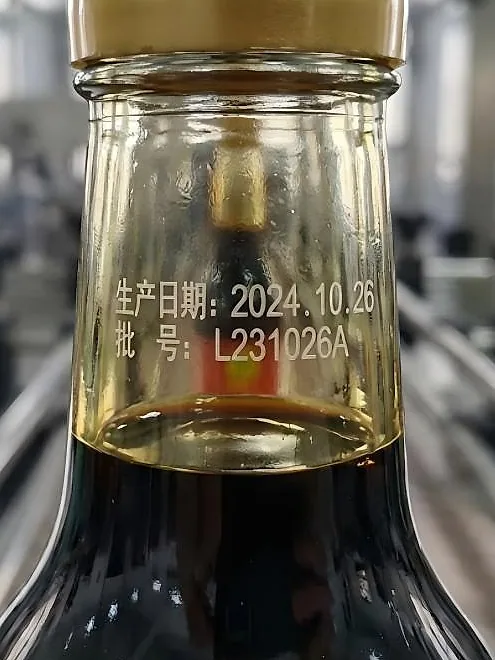
On a bottle the usable band is usually between label and base, or on the shoulder where the radius turns. A head held at fixed height loses focus as the surface curves away, so the width of the printable arc — not the height of the bottle — sets how much content fits. Shrink sleeves and caps add a second surface with its own behaviour: the sleeve is a different polymer from the bottle under it.
On a pouch, the code lands on a sealed flange or a clear panel, and both move. A filled pouch is never flat, so a code that prints cleanly can still crack when the pack is squeezed in transit. This is where we ask for filled, sealed samples rather than flat film.
On a carton the surface is absorbent and forgiving, but the code has to survive stacking, strapping and a forklift. There the failure mode is abrasion, not adhesion.
What does the code actually have to survive?
We ask this before we recommend anything, because what a date code has to survive moves the ink system more often than the material does. The same HDPE bottle can be fine in a dry warehouse and fail in a cold chain.
The four failure routes we see most often:
- 01
Rubbing and abrasion — the code sits where hands, rollers or stacked cases touch it. A thumb rub on a dried code is the fastest field test there is, and it is the one that most often fails.
- 02
Condensation and freezing — a pack that comes out of a chiller carries a film of water, and ink that was dry in the warehouse can lift when the surface is wet. A freezer changes both the substrate and the film on it.
- 03
Solvent wiping — cleaning routines, hand sanitiser and product spills put ethanol or IPA on the pack. A code printed for a dry environment can lose contrast or colour under a wipe.
- 04
Light and time — some marks fade rather than flake. That is a pigment question rather than an adhesion question, and it usually shows up months later, on stock that sat near a window.
Handheld or in-line: what changes, and what does not?
The choice between the two is usually settled by throughput and by how many different things you print on, not by print quality.
A handheld coder suits low volume, mixed cartons, and work where the pack does not travel on a conveyor: the operator positions the head, triggers the print and moves on. Its weak point is consistency — position and angle vary with the hand holding it, and that variation shows up as unreadable codes at the end of a shift.
An in-line unit takes its trigger from a photocell and its timing from a shaft encoder, so print position follows the product rather than the operator. It costs more to install and it needs a mounting point on the line, but it removes the human variable, and above a few thousand packs a shift it is the only practical route.
One thing does not change between the two: the cartridge and the ink are the same. Both run the same HP45-format TIJ cartridge, which is why the ink decision can be taken after the machine decision rather than before it.
To be clear about what we supply: we make the cartridge and we formulate the ink. The handheld and in-line printers are supplied together with specialist equipment-manufacturing partners — we qualify and support the combination, but the machine itself is not built in our plant.
Is it the date that is regulated, or the printing of it?
Date marking on food, pharma and cosmetics is governed by national rules that differ in what must appear, in which order, and at what minimum height. Those rules change, and they bind the party placing the product on the market, not the supplier of a cartridge.
So we do not tell customers what their pack has to say. What we can do is make sure the mark you are required to print is legible and stays legible: the right ink system for the surface, a print width that fits the content at the height your rule requires, and a check on your own line before a production run.
Where a machine-readable code is involved — a QR code, a DataMatrix, a serialised string — the reference the industry grades against is ISO/IEC 15415, the standard for two-dimensional symbol print quality. It defines the parameters a verifier reports and the grades it can return. If your customer specifies a grade, ask for it in the brief: it is a printing condition, not an afterthought.
What is the MRP mark, and what other local marks have to fit?
Some requirements are local rather than universal. In India, packaged goods carry the maximum retail price — the MRP — printed on the pack, and a coding line there often has to put the MRP, the batch number and the date in one pass. Comparable local marks exist in other markets.
These are not exotic printing problems. They are the same ink, surface and durability questions with more characters to fit, and the practical constraint is usually layout: how many lines of print fit into the band the pack allows. That is why we ask for the full content, not just the material, when a sampling request comes in.
How do I qualify a date code on my own line?
A sample printed on a clean lab coupon tells you what the ink can do. It does not tell you what your pack will do. The steps below are the ones we ask customers to run, in this order, to qualify a date code before a production run is committed.
- 01
Print the real content — the actual date format and the actual batch string — at the real line speed. A trial with placeholder text proves nothing about whether your content fits.
- 02
Read the result at the distance it will be read. A code that is crisp under a bench light can be unreadable across a shelf.
- 03
Rub it with a thumb, then with the solvent your cleaning routine uses, and look at contrast rather than at colour.
- 04
Send the sample through the next step in your own process — the chiller, the shrink tunnel, the case packer — and re-check it afterwards, not before.
- 05
Keep a printed sample at the temperature and humidity of your warehouse and look at it again in a few weeks. Fading is slow, and it is the one failure that sampling on day one cannot reveal.
- 06
If your customer verifies codes, scan the sample with the same verifier and confirm the grade before the run.
Standards and references
Where a figure or a method on this page rests on an outside standard, the standard is named here and linked to the publisher. We do not paraphrase what a standard says — the document itself is the authority.
- ISO/IEC 15415:2024 ISO/IEC
How the print quality of a two-dimensional symbol is measured and graded. If a customer specifies a grade, this is the document that grade is defined in.
- GS1 General Specifications GS1
The core GS1 document: how GS1 barcodes and identification keys are built and applied, and where GS1 DataMatrix is defined.
- GS1 — 2D barcodes in retail GS1
GS1’s own account of the migration to two-dimensional codes at retail points of sale — the context behind QR and DataMatrix appearing on consumer packs.
ISO and ASTM documents are sold by the bodies that publish them; the links open each publisher’s own page, where the abstract and scope are public.
Questions that come with a date-code enquiry
Which ink should I use for a date code on a chilled or condensed pack?
A solvent system, usually: condensation puts a film of water on the surface and water-based inks can lift off a wet surface. But the deciding factor is the substrate under the water and the temperature cycle, not the condensation alone. Send us the pack as it comes off your line and we will print on it.
Can a date code survive a solvent wipe?
Sometimes, and it has to be tested rather than assumed. Cleaning routines, hand sanitiser and product spills put ethanol or IPA on the pack, and a code printed for a dry environment loses contrast or colour under a wipe. The wipe test, with the solvent you actually use, is what settles it.
Do the regulations say how the date has to be printed?
They say what the mark must contain and that it has to be legible; they do not specify an ink, a font or a print technology. The requirement sits on the outcome — a date that stays readable for the life of the product — and it is set by the destination market, not by us. We can tell you what a given ink survives; we cannot tell you that you are compliant.
Do you supply the printer that prints the date code?
The cartridges and the ink are ours. The handheld and inline printers are supplied together with specialist equipment-manufacturing partners, and we qualify the combination so that the cartridge, the ink and the machine settings work as one system. Tell us the code content and the line speed and we will specify the combination.
Send us your material. We send back a printed code.
Tell us the material, the line speed and what you need to print. We will name the ink system and post you samples you can test yourself.