
Engineering
Cable and pipe coding: a mark that survives the line, the drum and the ground
Something is always moving on a cable or pipe line. The product does not stop for the head, and on an extrusion run the ink has a fraction of a second to dry before the first capstan or the water trough. Three things decide whether the mark survives: the jacket or wall compound, where the head sits relative to the cooling trough and haul-off, and what happens to the coil — winding, dragging, burial, sunlight, a pressure test.
What gets printed onto cable and pipe, and why the length mark changes the job
Most of what goes onto a jacket is identification: type and size, voltage or pressure class, the standard the product is made to, the maker, and a batch or date code. Those items behave much the way they do on any other product, and the date and batch side of it is covered on its own page.
The length mark is the item that changes the problem. A metre mark is not a fixed string, it counts: it has to increment with the product, stay in step with the haul-off at running speed, and pick up again in the right place after a line stop. That is an encoder and controller question before it is an ink question, and it is why a cable enquiry looks different from a carton enquiry.
Pipe usually carries simpler content and harder conditions. The mark is often the material, the diameter and pressure class, the standard reference and the production date, repeated at intervals along the extruded length rather than printed continuously. What it then has to survive is a life outdoors or underground, which is a different test from a shelf life.
Why soft PVC, rigid PVC and polyethylene behave differently on the same line
Rigid PVC is the easy case. Published ranges put it around 38–40 mN/m, which a solvent ink wets without pretreatment. Soft PVC is the one that catches people out, and adhesion is not the reason. A flexible compound carries plasticiser, and plasticiser migrates toward the surface over time — so a mark that held on the day it was printed ends up on a layer that keeps changing underneath it. Rigid PVC has little or no plasticiser and does not behave this way. It is the most common cable complaint we see.
Polyethylene sits at the other end. PE, XLPE and PE pipe are polyolefins: untreated they fall below the surface tension of a coding ink, so a mark can look right and then fail a thumb rub. Published ranges put HDPE at roughly 28–32 mN/m untreated against 38–42 after treatment. Extrusion lines often carry a corona or flame station for exactly this reason, and where there is one the head belongs after it. The full surface-energy table is on our substrate matching guide.
Rubber, nylon and PU jackets are a third case: they vary by compound, and the honest answer for all three is a printed sample on your own stock.
Which ink system fits a cable or pipe line
A solvent system is the usual starting point, because nothing soaks into a PVC jacket or a PE pipe wall: the carrier has to flash off. On a fast line that is the whole problem, and the drying budget is arithmetic — the distance from the printhead to the first capstan, water trough or coiler, divided by the line speed.
Two points about line layout matter more than anything on an ink datasheet. Where the head sits relative to the cooling trough: a product printed warm dries faster but its dimensions are still moving, while a cold, dimensionally stable surface is harder to wet. And whether the product passes a water trough or a spark tester after the head: a wet surface and a wet print are not the same thing, and the print has to be dry before it gets there.
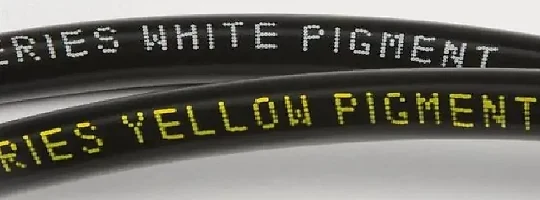
For this case we supply a 42 ml cartridge in the HP45 format, in 12.7 mm and 25.4 mm print widths, and we formulate the ink ourselves. Print width is what decides how much content fits in a single pass. Stacking heads extends the height, at the cost of one more alignment to hold and one more place for a dropout to appear.
How to qualify a mark on your own cable or pipe
A sample printed on a flat coupon tells you what the ink can do. It does not tell you what a moving jacket or a coiled pipe will do. These are the steps we ask customers to run, in this order, before a production run is committed.
- 01
Send a length of the real product: same compound, same colour, same surface as it comes off the line, including any treatment, and not cleaned up for the trial.
- 02
Print at the real line speed with the real content, including the length mark. A fixed string is not a test of whether the count keeps step.
- 03
Rub it with a thumb, then with the solvent your cleaning routine uses, and look at contrast rather than at colour.
- 04
Coil or reel the sample and leave it. Winding tension, contact between layers and the curvature of a reel are part of the test, and a straight sample never sees any of them.
- 05
Put the sample through what the product actually meets: the water trough, the spark tester, dragging through a duct, a pressure test, a season outdoors. The failure customers report is rarely the one that showed up on the bench.
- 06
Tell us early if the product carries a standard reference or a third-party mark. The declaration sits with the party placing the product on the market, and it changes what the sampling brief has to cover.
Handheld or in-line — and what we actually supply
On a continuous extrusion run this is usually not a choice. Nobody stops an extrusion line to mark the product by hand, so the head is mounted on the line, takes its trigger from an encoder or a proximity switch, and prints while the product moves. What is achievable in one pass depends on the print height, the number of lines and the ink, and it is bounded by how much time the surface gives the drop to dry — which is why we ask for the line speed and the print height rather than quoting a figure in advance.
A handheld unit still has a place further down the process: re-marking a cut length, marking the end of a coil, coding drums and pallets, or short runs where setting up a station on the line is not worth the effort. On a curved, glossy jacket its weak point is consistency, because position and angle vary with the hand holding it.
To be clear about what we supply: we make the cartridge and we formulate the ink. The handheld and in-line printers are supplied together with specialist equipment-manufacturing partners — we qualify and support the combination, so that cartridge, ink and machine settings work as one system, but the machine itself is not built in our plant.
What we need from you to quote a cable or pipe application
A cable or pipe enquiry can usually be answered properly the first time if the brief carries a few specifics. This is the list we ask for; anything you cannot answer yet, we can work out together from a sample.
- 01
A length of the jacket or profile as it comes off the line, including any surface treatment, and not cleaned up.
- 02
The compound: rigid or soft PVC, PE, XLPE, PP-R, PEX, rubber or nylon.
- 03
The line speed in metres a minute, and the distance from the printhead to the first roller, water trough or coiler.
- 04
The content, the number of lines and the height each line has to be, and whether the length mark has to increment.
- 05
The coil or reel length, the monthly volume, and the destination market if the product carries a standard reference.
Standards and references
Where a figure or a method on this page rests on an outside standard, the standard is named here and linked to the publisher. We do not paraphrase what a standard says — the document itself is the authority.
- ASTM D2578 ASTM International
A wetting-tension (dyne) test method for polyethylene and polypropylene film. It measures the state of a treated surface; it does not by itself predict how an ink will hold.
ISO and ASTM documents are sold by the bodies that publish them; the links open each publisher’s own page, where the abstract and scope are public.
Questions that come with a cable or pipe enquiry
Why does the code lift on soft PVC but hold on rigid PVC?
Because on soft PVC the ink is not failing against the PVC. The compound carries plasticiser, and plasticiser migrates towards the surface over time, so a mark that tested well on day one can end up sitting on a layer that keeps changing. Rigid PVC has little or no plasticiser and does not behave this way. Send a length of the actual compound, coil it, and look at it again after a few weeks rather than after an hour.
Do PE and XLPE jackets, and PE pipe, need corona or flame treatment before coding?
Often, and it is worth verifying rather than assuming. Untreated polyethylene is below the surface tension of a coding ink, so the drop rests on the surface instead of wetting into it; published ranges put HDPE at roughly 28 to 32 mN/m untreated against 38 to 42 after treatment. Two cautions: treatment decays over storage, and where your line already has a corona or flame station, the printhead belongs after it, not before.
Can a TIJ cartridge keep up with a line running hundreds of metres a minute?
That depends on the print height, the number of lines and the ink, not on one headline speed, so we will not quote a number in advance. The governing factor is the drying window: the distance from the head to the first thing that touches the print, divided by the line speed. Give us the line speed, the content and the print height, and we will qualify it on your own material and tell you what the combination does.
Do you supply the printer for an extrusion line, or only the cartridge and ink?
The cartridge and the ink are ours. The handheld and in-line printers are supplied together with specialist equipment-manufacturing partners, and we qualify the combination so that cartridge, ink and machine settings work as one system. Tell us the line speed, the product and the content and we will specify the combination.
Send us your material. We send back a printed code.
Tell us the material, the line speed and what you need to print. We will name the ink system and post you samples you can test yourself.