
Printers
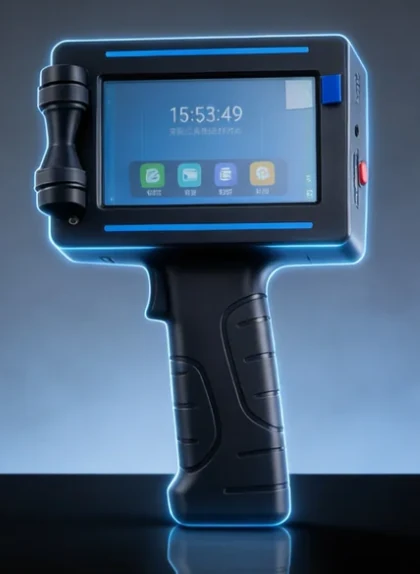
Handheld TIJ Printer · 25.4 mm Print Width
A one-inch handheld coder for content that does not fit half an inch: multi-line blocks, QR and Data Matrix codes, and logos applied in a single sweep. If half an inch will not hold your content, this is the model to compare.
Key specifications
- Model
- XM-H25
- Type
- Handheld
- Print height
- 2 mm – 25.4 mm, set by character height and line count
- Print width
- 25.4 mm (one-inch)
- Resolution
- 600 dpi, print-mode dependent
- Throw distance
- 2–5 mm (1–2 mm gives the best placement accuracy)
Published unit price
USD65
- EXW — factory price, freight and duty not included
- In stock — dispatch follows the stock position on the day you order; if stock is short, the unit is assembled before it ships
- 30-day full refund if the goods do not match what this page describes
Overview
The one-inch handheld exists for one reason: content that physically does not fit in 12.7 mm. A QR or Data Matrix code needs enough modules to survive being scanned at line speed, and putting that code next to a date line takes width the half-inch band does not have. Compressing it is not a solution — it produces a code that fails at the scanner and gets caught at the end of the line rather than at the printer.
The cost of the extra width is weight and handling. A one-inch cartridge body is larger and heavier, so the unit is less comfortable over a long shift than the half-inch model, and it is noticeably more awkward when printing on a vertical or overhead surface. If the content genuinely fits in half an inch, the smaller unit is the better tool — this is not an upgrade in any general sense.
It is also worth checking the printer model before buying cartridges. Some compact handheld units have a cartridge seat that only accepts the half-inch body. Confirm the model, and if it is ambiguous, order a single cartridge and test the seat before committing to a volume.
Design points
Multi-line content in one pass
25.4 mm of print height fits a full block — product name, date, batch, serial and a QR code — without splitting the print into two operations.
QR and Data Matrix without shrinking
The code keeps enough modules across to be read by a standard end-of-line scanner at normal line speed, instead of being compressed to fit a half-inch band.
Space for logos and graphics
Brand marks and simple graphics can be printed alongside the variable data in the same sweep, avoiding a second marking operation.
Same platform as the rest of the range
Identical HP45-format thermal inkjet platform, so ink systems, colour options and service practice carry over from the other units in the range.
Six-language touchscreen
On-device editing in English, German, French, Spanish, Portuguese or Arabic, with templates for content that repeats.
Open chip cartridge
Non-encrypted, no authentication handshake, no single-use lock-out — the same cartridge policy across handheld and inline units.
Full technical data
| Model | XM-H25 |
|---|---|
| Type | Handheld |
| Print height range | 2 mm – 25.4 mm, set by character height and line count |
| Print width | 25.4 mm (one-inch) |
| Resolution | 600 dpi, print-mode dependent |
| Print speed | Hand-speed dependent; the internal encoder wheel matches print timing to the sweep |
| Throw distance | 2–5 mm (1–2 mm gives the best placement accuracy) |
| Head configuration | Single one-inch cartridge seat; stitched operation is not applicable to handheld units |
| Trigger | Manual trigger with an internal encoder wheel that synchronises firing to the sweep speed |
| Power | Rechargeable lithium-ion battery, sized for a working shift of intermittent use |
| Protection | Designed for dry indoor use; not a washdown-rated enclosure |
| Ink systems | Water-based (carton, paper, wood); Solvent fast-dry (plastic, coated metal, film); Covert UV (authentication marking) |
| Interface languages | English, German, French, Spanish, Portuguese, Arabic |
| Print technology | Thermal inkjet (TIJ), one-piece HP45-format cartridge |
| Coding content | Multi-line text, date and time, batch and lot, incrementing serial, barcode, QR code, Data Matrix, simple graphics |
| Interface | Colour touchscreen; six interface languages |
| Weight and handling | Heavier than the half-inch model; a two-hand grip is advisable on vertical or overhead surfaces |
| Substrates | Carton, paper, wood, plastic, coated metal, film, glass — ink system must be matched to the surface |
Ink base
- TIJ 2.5 Solvent Cartridge HDPE, PP, PET, coated metal and film
- Invisible UV Security Ink Covert authentication and traceability marking
Confirm by sampling on your own substrate
Typical applications
- One-pass marking of a full data block including a QR or Data Matrix code
- Traceability and serialisation where hand-held operation is unavoidable
- Pharmaceutical, cosmetic and premium packaging requiring a compact multi-line block
- Large parts and fabrications needing name, date, serial and a scannable code together
- Warranty and asset marking with a unique identifier per unit
Engineering notes
- 01
Confirm the cartridge seat before ordering volume. Not every handheld unit accepts a one-inch body, and the physical fit cannot be resolved by firmware or a print setting.
- 02
Test scan reliability, not print appearance. A QR code can look perfectly crisp to the eye and still fail at the scanner because the module size is marginal for the scanner's optics.
- 03
The extra width is paid for in handling. Where the code has to be applied overhead, at height, or in a confined space, weigh the ergonomics before choosing this model over the half-inch unit.
- 04
Multi-line content increases ink load per mark, which reduces cartridge life per unit printed and lengthens the drying window. Both effects are modest individually and material together — run a realistic volume test rather than extrapolating from a single-line figure.
Why one inch is a content decision, not a specification upgrade
The half-inch and one-inch handheld units are the same technology. The difference is how much content fits in a single sweep, and that is a hard physical limit rather than a setting.
A QR code carries a fixed number of modules. Those modules have to be large enough for the scanner’s optics at the distance and speed they will meet. A version 4 QR code has 33 modules across; printed in a 25.4 mm band that is 0.77 mm per module, and in a 12.7 mm band it is 0.38 mm. The second figure is below what many standard industrial scanners resolve reliably at line speed — which is why half-inch QR projects so often end with a scanner rejection that has nothing to do with print quality.
The same arithmetic applies to multi-line blocks. Five lines at 4 mm character height need about 22 mm of band once line spacing is included. That does not fit in 12.7 mm at any setting.
The costs that come with the wider band
Being honest about the trade-offs is more useful than listing features:
| Consideration | Effect of the one-inch body |
|---|---|
| Unit handling | Heavier and bulkier; less comfortable over a full shift, awkward overhead |
| Cartridge cost | Higher per cartridge, though the cost per printed mark is closer than the list price suggests |
| Ink load per mark | Higher, which shortens cartridge life per unit printed |
| Drying window | Longer, because more ink has to dry — matters on non-porous surfaces |
| Printer compatibility | Requires a cartridge seat that accepts the one-inch body |
| Placement repeatability | Marginally harder to hold steady over a wider sweep |
The last row is worth dwelling on. A wider print band means the operator has to keep the unit level and at a consistent distance across a longer stroke. Neither model gives coordinate-accurate placement, but the wider band amplifies any wobble. If the code must sit inside a printed box on the pack, test the placement spread on a run of pieces before committing to the handheld approach at all.
Where this model should not be used
If the volume is high and the content is fixed, an inline head will do this job faster, more consistently and at a lower cost per mark. A handheld unit on a high-volume line is a bottleneck that also introduces operator-to-operator variation into your traceability data — the codes are correct, but they are not in the same place, which matters the moment anyone tries to automate inspection.
Questions engineers ask
Will a one-inch cartridge fit my handheld printer?
Not necessarily, and this is worth checking before anything else. Some compact handheld units have a cartridge seat that only accepts the half-inch body, and no firmware setting changes that. Send us the printer make and model — or order a single cartridge and test the seat before you commit to a volume.
My QR code will not scan. Is it the printer?
Usually it is module size relative to the scanner's optics, not print quality. A code can look crisp to the eye and still be too dense for a standard industrial scanner at line speed. Test with the actual scanner, at the actual speed, at the actual working distance — and if the code is being printed in a half-inch band, moving to this one-inch unit is often the fix.
Is it much heavier than the half-inch model?
Noticeably, because the cartridge body is larger. Over a full shift it is a real difference, and on vertical or overhead surfaces we recommend a two-hand grip. If your content fits in 12.7 mm, the smaller unit is the more comfortable tool — the extra width is not an upgrade unless you need the content space.
Does more ink per mark mean more cost?
Yes, and it affects two things. Cartridge life per unit printed is shorter because each mark uses more ink, and the drying window is longer because there is more ink to dry. Both effects are modest on their own and material together, so run a realistic volume test with your actual content rather than extrapolating from a single-line figure.
Can it be used for serialisation?
Yes. Incrementing serials and variable data are supported, and the one-inch band has room for a unique identifier alongside a QR code — which is the combination most traceability programmes need. Whether handheld is the right delivery method for your volume is a separate question, and we will help you assess it.
Send us your material. We send back a printed code.
Tell us the material, the line speed and what you need to print. We will name the ink system and post you samples you can test yourself.