
Technical Notes
Coding on Flexible Packaging: Why the Pouch Is the Hard Case
A flexible pack is printed on a moving web, sealed next to the code, and often stored cold. Each of those decides something about the mark. Here is what to settle before your first production run.
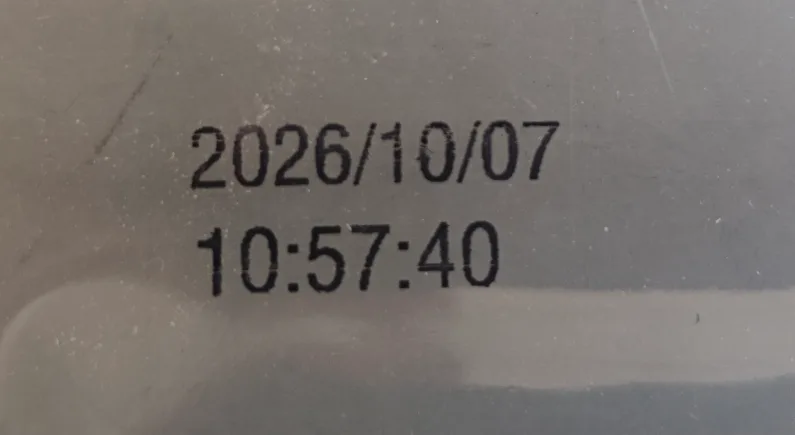
A rigid bottle presents a stable, self-supporting surface at a fixed height. A flexible pack does none of that.
The film is a few tens of micrometres thick, it is usually running, it may be formed into a pouch a few centimetres after the print, and it is often filled while still warm or stored below zero. The ink is asked to survive all of it.
Which is why a code that behaves perfectly on an HDPE container can fail on a laminate pouch without the ink being at fault. Coding on rigid plastic covers the bottle case; this page covers what the pouch adds. The four failure points below are where most first production runs go wrong.
Why a flexible pack is a different problem
The seal area decides where the code can go
The most common layout mistake on a pouch is placing the date close to, or across, the seal. Two things follow.
First, ink inside the seal zone is contamination. A seal is formed by heat and pressure fusing two polymer layers; a layer of dried ink or a solvent residue between them is a foreign body at exactly the point that has to hold. Whether it matters depends on the seal type, the film structure and the fill, but it is not something to discover during a leak test.
Second, the seal is a deformation zone. The film is compressed and thinned where the jaws close, so a code printed there can be distorted exactly where legibility is decided. The practical rule is to keep the code inside the print area the converter has already qualified, and to ask for that boundary in millimetres rather than “away from the seal”.
The web is moving, and it stretches
Printing on the reel rather than on the finished pack changes the mechanics. An inline station holds a throw distance of 0.5–8 mm, and on a moving web the film’s position within that window is not constant: tension variation, web wander and the elasticity of the laminate all move the surface towards and away from the head.
The consequence is a specification question rather than an ink question. If the film moves vertically by more than the useful part of the throw distance, no ink choice will make the code consistent, and the answer is web guidance or a different mounting point. If the code carries a QR or Data Matrix, add the print-width check: a 12.7 mm cartridge and a 25.4 mm cartridge print the same content at different densities, and a dense code needs more room than its text suggests.
Heat is the other half. The film may still be warm from a forming or filling step, and a warm surface takes ink differently from a cold one. Drying figures follow the same caveat: our fast-dry solvent inks are typically dry to the touch in 1–5 s on non-porous surfaces, and that is a published range for the ink class, not a promise for a web that is also being pulled and cooled. The inks are ours — formulated and filled in house — which is why the drying band here can be discussed at formulation level rather than as a fixed figure; the manufacturer page sets out where that starts and stops.
Blocking: when the next layer takes the ink
On a reel, freshly printed film is wound onto itself. If the ink has not fully set, the next layer can lift part of it — the defect appears as a patchy, mirror-image loss rather than as a smear, which is why it is often misdiagnosed as an adhesion failure.
Three variables decide whether blocking happens: how much ink is laid down, how quickly the carrier leaves it, and how hard the reel is wound. A dense block of variable data puts far more ink on the film than a short date, so a job that runs cleanly with three characters can block when the artwork grows. The fix is usually mechanical — a chilled or longer path before rewinding, or a lighter wind — rather than chemical.
Cold, condensation and the rub that follows
A pack that goes into a chiller or a freezer meets conditions the print never saw at the coding station. Condensation forms on the surface, and the film and the ink contract at different rates. Then the pack is handled: pulled from a shelf, stacked, rubbed against its neighbours.
This is where surface energy matters most, because the numbers move. Untreated PE and PP sit around 26–32 mN/m, and a coding ink needs the substrate to be roughly 8–10 mN/m above its own dynamic surface tension, which is why corona or flame treatment typically lifts the surface to about 38–42 mN/m. The catch is that the treatment is not permanent: it decays with storage, so a reel treated six months ago is not the reel that was measured. On film that will be stored cold, treat the treatment date as part of the specification.
Where the surface is genuinely unpromising, a UV-curable system is the route that does not depend on the film absorbing anything — the note on UV-curable TIJ on PE and PP film works through why curing and bonding are two separate questions.
What to send for a film trial
Film is where a datasheet comparison is least useful, because the variables that decide the outcome are physical and local. Send us:
- The film structure, with the seal type and the print position marked on a sample or a drawing.
- The finished pack, or a filled one, so the code can be judged after forming and sealing rather than on the flat web.
- The line speed, whether the film is printed on the reel or on the formed pouch, and the throw distance available.
- The cold chain: ambient, chilled, frozen, and whether condensation is present when the pack is handled.
- The code content and size, including any QR or Data Matrix.
With those, the answer usually arrives as a printed sample on your own film rather than as an opinion. If the mark has already failed in production, the adhesion diagnostics separate the four common causes in the order that costs least to test. If the pack is rigid rather than flexible, the substrate matching guide is the faster route; and if the platform is still open, the inline station page carries the configuration table. Anything unclear, send us the details.
Related reading
- 30 October 2026
How Solvent TIJ Cartridges Are Made: Inside a Manufacturer's Line
A solvent TIJ cartridge is not bought parts relabelled. It is ink formulated and filtered, a body prepared and…
- 29 October 2026
How Much Does a Solvent TIJ Cartridge Really Cost? Cost per 1,000 Prints
USD 28–58 buys a solvent TIJ cartridge, and that number decides nothing. What reaches your margin is the cost …
- 28 October 2026
HP 2580 vs 2590 vs XM-45S: Which Solvent TIJ Cartridge Fits Your Line?
The number on the label decides three separate things — ink behaviour, chip and print height — and they do not…
Want this confirmed on your own material?
We print on samples of your actual substrate and send them to you. Send the material, the line speed and the code content, and we will tell you honestly whether the fault is the ink, the surface or the line layout.