
Technical Notes
How Solvent TIJ Cartridges Are Made: Inside a Manufacturer's Line
A solvent TIJ cartridge is not bought parts relabelled. It is ink formulated and filtered, a body prepared and chipped, a vacuum fill to 42 ml, a seal, then every unit weighed, inspected and print-tested. Six stations, and what each one means for your line.
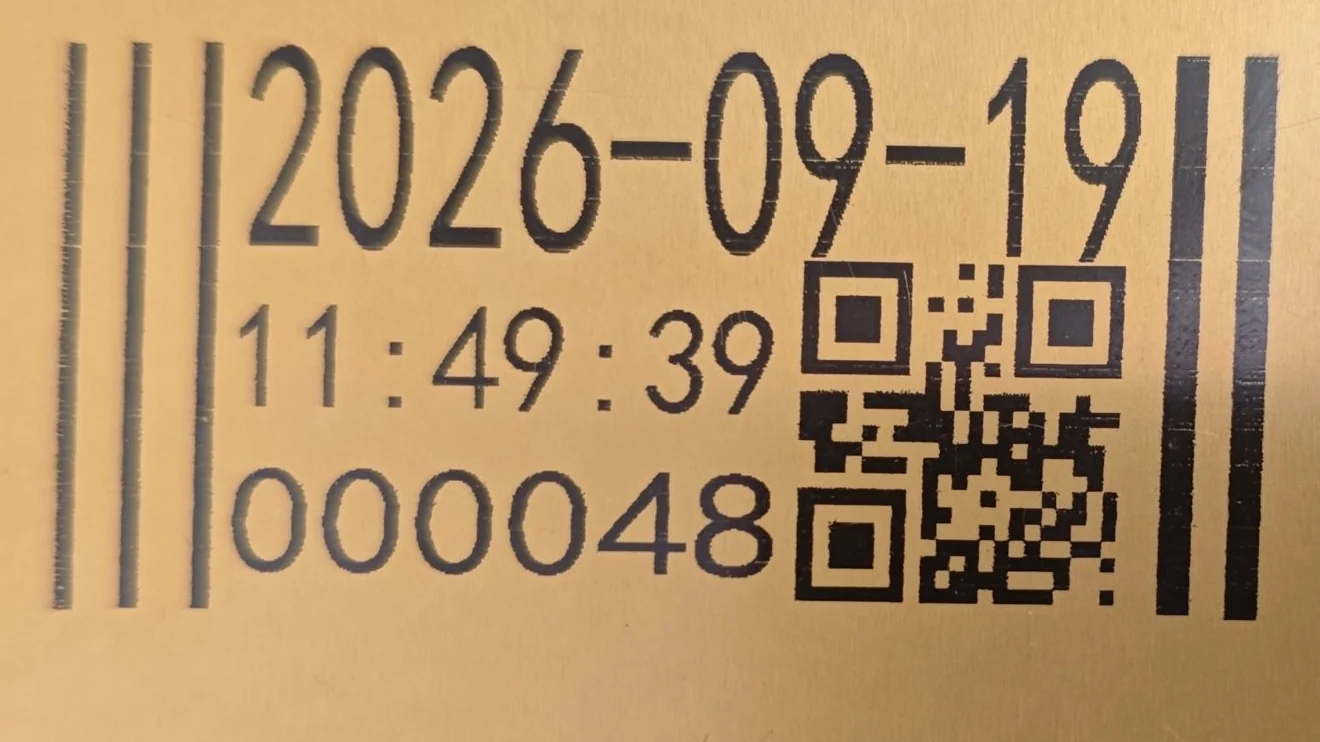
A solvent TIJ cartridge is made, not assembled
The honest version of “made” is six stations on the manufacturer’s own line. The ink is formulated and filtered. The HP45-format body is prepared and the chip is mounted. The cartridge is filled under vacuum to a 42 ml industrial fill. It is sealed and capped. Every single unit is weighed, visually inspected and print-tested. Then it is packed with traceability.
That is the whole article in one paragraph, and it is the accurate answer to how solvent TIJ cartridges are made. What follows walks the line station by station and explains what each step prevents. If you are new to the category, read what a solvent TIJ cartridge actually is first; this page is about how it comes into existence.
Why the making matters more than the marketing
Most cartridge marketing talks about the ink. The ink matters, but a TIJ cartridge is a sealed assembly — reservoir, filter and printhead in one unit. There is no separate printhead to clean or align, no service visit that fixes a weak nozzle, no downstream step that compensates for a bad build. A failed nozzle is fixed by changing the cartridge.
That single fact is why manufacturing is the product here. On a CIJ printer a service engineer can tune around a problem. On a TIJ cartridge, whatever left the factory is what prints on your line. Consistency of the making process is consistency of the code on your product. So when a supplier says “manufacturer”, the useful question is never the slogan — it is what happens on their line, station by station, and whether every unit goes through it or only some.
There is a second reason, commercial rather than technical. Buyers in this category often qualify a second source: the same HP45-format cartridge from an independent maker, running alongside the existing supply. The chip on our cartridge is open and non-encrypted — no authentication handshake, no single-use lock-out — which is what makes second-source qualification possible without replacing printers. But the chip only opens the door. What decides whether the second source survives on your line is whether the cartridge is built the same way every time. That is a manufacturing question, and this article answers it the way we would want it answered about any supplier: with the stations.
Which is also why this is a narrower business than it looks from outside. A cartridge is broadly a body, a chip, a filter, a printhead and a fill, and the ink decides most of the behaviour. A supplier who buys all five and boxes them is not doing the same job as one who formulates and fills, even when the carton looks identical and the datasheet quotes the same numbers.
Who is writing this, and what we do not claim
XinmoJet was registered in August 2026, and we claim no longer history than that. The experience sits with the people: everyone on our team came from inside the TIJ cartridge industry, with more than ten years each across cartridges, printheads and ink, before joining us.
We also state the boundary of what we make, because it is where most supplier pages get vague. We formulate the inks and we build and fill the cartridges. We do not make printers, and the printhead inside the cartridge is not ours — we qualify it rather than manufacture it. We list no certification marks either, because we will not display a CE, RoHS or ISO mark before the certificate is in hand. What we can show is the line itself, which is what this article does.
The six stations, and what each one prevents
The table is the summary; the sections below it are the detail. Every row describes something that would fail somewhere else if the station were skipped.
| Station | What happens | What it prevents |
|---|---|---|
| Ink formulation and filtration | Mild-solvent ink formulated and filtered on our own lines | Nozzle clogging, batch-to-batch drift |
| Body preparation and chip mounting | HP45-format body prepared; open, non-encrypted chip mounted | Chip-fit and handshake failures at the printer |
| Filling | Vacuum fill to a 42 ml industrial fill | Short cartridge life hidden inside the same shell |
| Sealing and capping | Cartridge sealed; protective cap fitted | Drying in storage, leakage in transit |
| 100% testing | Every unit weighed, visually inspected, print-tested | Dead-on-arrival units and weak nozzles reaching you |
| Packing and traceability | Packed in standard cartons, 160 per carton | Transit damage, untraceable batches |
Station 1: Ink formulation and filtration
Solvent cartridges are one of four ink systems formulated, filled, sealed and tested on our own lines — alongside water-based, oil-based and covert UV systems. Our solvent ink is a mild-solvent formulation: the lower-aggression end of the solvent family, chosen to wet hard-to-wet surfaces and to survive pauses rather than to dry as fast as possible. That is the same direction as the HP 2580 system, which our factory places our XM-45S cartridge in — a system correspondence, not a specification match, as set out in HP 2580 vs HP 2590 vs Xinmo XM-45S.
Solvent ink formulation happens before anything touches a cartridge body, and filtration is part of the same station. Ink is filtered to remove the particles that would otherwise lodge in a nozzle. A TIJ nozzle fires droplets measured in picolitres — our published drop volume is approximately 29–38 pl depending on model and print mode — and at that scale a particle you cannot see is a blocked nozzle. This is the least visible station on the line and one of the most consequential: an unfiltered or inconsistently filtered ink does not fail at the factory, it fails weeks later on your line, one nozzle at a time.
The order of work matters too. Ink is formulated in batches and filtered before filling starts, not topped up during a run, because the moment ink and body meet there is no way to inspect what went in. Anything wrong with the batch is a batch problem, and it is cheaper to find it at the filter than at your line: a rejected batch costs a day, a bad cartridge costs a customer.
We publish the ink class (mild-solvent) and not the formula. Formula ratios are not disclosed, and you do not need them to buy well — what you need is the behaviour they produce, which is why we publish drying, decap and drop figures with their conditions on the solvent cartridge page, and why we print samples on your own material before any quantity order.
Station 2: Body preparation and chip mounting
The cartridge body is the HP45-format TIJ 2.5 body: 300 nozzles per row, 12.7 mm or 25.4 mm print width depending on model (XM-45S-127 and XM-45S-254), native 300 dpi up to 600 dpi depending on print mode. Before filling, the body is prepared and the chip is mounted.
The chip deserves a paragraph because it is where second-source purchases most often fail. Our cartridge uses a non-encrypted, open chip: no authentication handshake the printer must complete before it will fire, no single-use enforcement, no firmware gate that rejects the cartridge for not being an original part. That is a deliberate choice — a second source only works if the machine accepts it. The compatible 2588 family, by contrast, is where buyers meet the opposite problem: units described as fitting the 2580/2590 body whose usability depends on the chip set fitted, which varies between makers and batches. Same body, different outcome at the printer.
The chip is mounted and its seating checked before the cartridge moves to filling, because a chip problem found after filling is a filled cartridge scrapped.
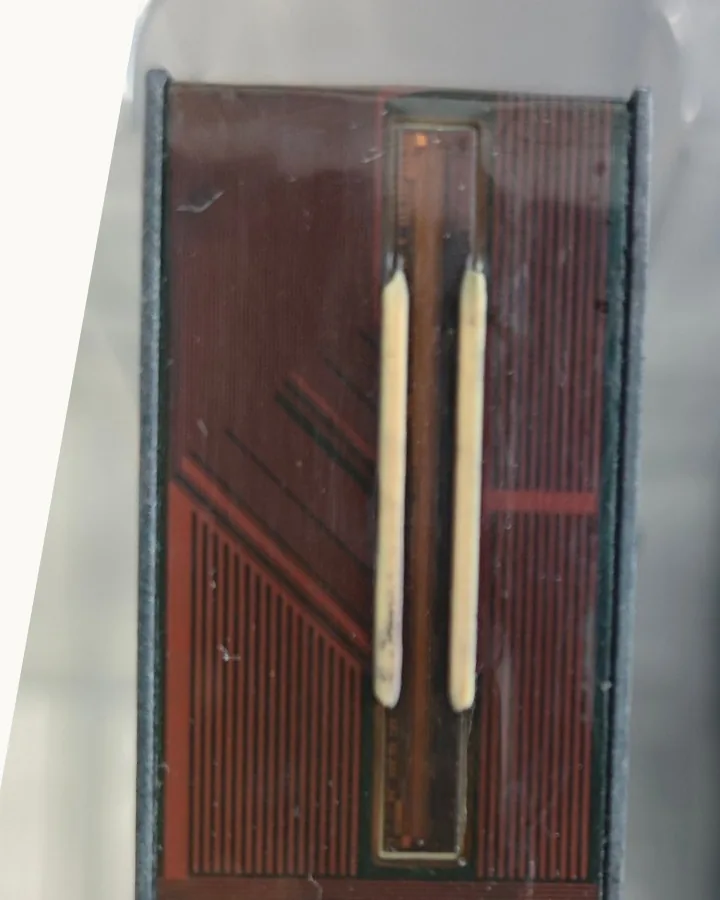
Station 3: Filling, and what the 42 ml claim actually says
Filling is done under vacuum to a 42 ml industrial fill. “Industrial fill” is a specific claim and worth understanding, because the shell is the same either way: a “service fill” cartridge offered at a lower price often carries noticeably less ink in the same HP45-format shell, since the shell is the fixed cost and the ink is the easiest thing to reduce. The defence is simple, and we state it on our solvent cartridge page: ask for the fill volume in millilitres rather than trusting a page count. We publish 42 ml.
What 42 ml does not do is convert into a number of marks. Cartridge life is governed by character height and content density, not by volume alone, which is why we publish the fill and nothing about life, and why the cost-per-1,000-prints article works from counted trials instead of generic figures. Filling sets the ceiling; your message decides how much of it you use.
Station 4: Sealing and capping
After filling, the cartridge is sealed and the protective cap is fitted. A TIJ cartridge is a sealed assembly by design — reservoir, filter and printhead in one — and the seal is what keeps it that way through storage and transit. The cap keeps the nozzle plate from drying while the cartridge waits.
This station is unglamorous and non-negotiable. A solvent ink that evaporates fast on the product, typically 1–5 seconds on non-porous surfaces, will also evaporate from an unsealed nozzle plate. The published decap behaviour — the head idles roughly 10–15 minutes on fast-dry solvent before the nozzle plate begins to dry, to be confirmed per ink — assumes a cartridge that was sealed properly at the factory and capped whenever it sits idle on your line. A badly sealed cartridge arrives with a drying problem already started, and no capping routine at the customer end recovers it.
Station 5: 100% testing — weighing, visual, print
Every unit. Not a batch sample — every cartridge that leaves the line is weighed, visually inspected and print-tested.
Weighing verifies the fill: a cartridge that weighs light did not get its 42 ml, and weight is the fastest honest check of that. Visual inspection catches what weighing cannot — seal defects, label errors, cap seating, any physical flaw from the stations upstream. The print test fires the nozzles and checks the output, so a weak or dead nozzle is caught here, at the factory, instead of on your line during a production run.
This is the station buyers should ask about first, because it is the one most often diluted. “Tested” on a datasheet can mean anything from every unit through three checks to a sample pulled once per shift. Our 100% cartridge testing means three checks on every unit; a unit that fails any of them does not ship. If a supplier cannot name their tests and their coverage in one sentence, that sentence is your answer about their line.
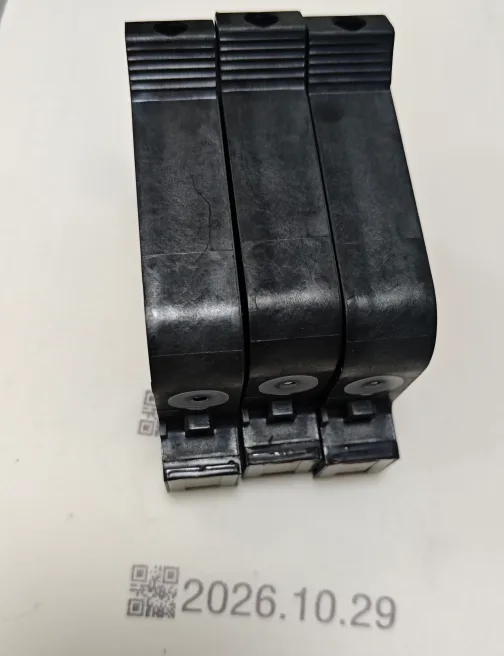
Station 6: Packing and traceability
Cartridges are packed in standard cartons — 160 cartridges to a carton, which is also our minimum order quantity. Packing is protection and traceability: protection because a cartridge is a precision assembly travelling as freight, and traceability because if a question ever arises about a batch, the batch has to be findable.
Our commercial terms ride on the same page as the manufacturing: minimum order 160 cartridges, ships within 3 working days of payment, EXW, with the full published terms on the pricing page.
Reading a factory’s numbers without fooling yourself
A factory tour, a brochure, or an article like this one will give you numbers. Here is how to read ours.
We run four filling lines, at roughly 2,000 cartridges a day. That figure is plant-wide across all four ink systems — water-based, solvent, oil-based and covert UV — and it is not a solvent-only figure. We state this explicitly because the number gets misread in both directions: quoted as a solvent-line capacity it would be an invention, and we will not invent it. What the figure does tell you is the scale of the operation and its scheduling discipline. Tell us your quantity and your date, and we confirm solvent-line scheduling for that order rather than quoting a generic daily number.
The rest of the numbers are terms, not quality claims: MOQ 160 cartridges (one carton), shipment within 3 working days of payment, EXW with CIF/DAP quotable on request, and a 30-day full refund if the goods do not match the published description. None of these proves a cartridge is good. They prove the factory can state its terms plainly, which is a smaller claim and therefore a more trustworthy one. The proof of the cartridge is the sample.
Two things you can check from a desk, before any visit. First, whether the numbers agree with each other across the supplier’s own pages: a fill volume on one page and a different one in the datasheet is not a typo you should absorb, it is a sign that nobody owns the specification. Second, whether each figure arrives with its condition — a drying time without a substrate, a daily output without saying which lines it covers, a compatibility statement without naming the chip. A number without its condition is not a measurement; it is a sentence that sounds like one.
Five questions that separate a manufacturer from a packing operation
If you visit a factory — ours or anyone’s — or if you are qualifying a supplier from a distance, these five questions do most of the work. The full manufacturer evaluation checklist covers the longer list; these are the five we would ask first.
Do you formulate the ink yourselves, or buy it in? A manufacturer formulates. A packing operation buys ink and a body and puts them together. Both can sell you a cartridge; only one of them controls what is inside it.
Is every unit tested, or batch-sampled — and which tests? Listen for named tests and coverage in one sentence. “We test our products” is not an answer.
What is the fill in millilitres, and how is it verified? The answer should be a number and a method — ours is 42 ml, verified by weighing every unit.
What is the chip, and is there a single-use lock-out? This decides whether second-source qualification is even possible on your printers.
Can I see the filling line and the test stations? A real line has little to hide. And then the question that matters more than the tour — can I get a sample printed on my own material?
The step that matters more than the tour: the sample
A tour shows you the line. A sample shows you the result — on your product, at your speed, in your hall. We print samples free of charge on your own material: send the substrate you actually code on and the code content, and the sample is printed on the second working day after your material arrives. That is deliberately the fastest commitment on this page, because it is the one that predicts your production.
Everything above — the six stations, the 100% testing, the numbers read honestly — is the reason the sample is worth running. The sample is the verdict. If it does not convince your operators, your existing setup has not changed, and that is the honest basis on which a second source should be qualified.
Start at the contact page with your material, line speed and code content; there is a longer walkthrough of how a trial is set up in cartridge compatibility and the sample trial. For private-label and adjusted-ink work, the OEM/ODM page sets out the process, MOQ and lead time.
Questions buyers ask about how the cartridges are made
Are the ink and the cartridge made in the same factory?
Yes. Solvent cartridges are one of four ink systems formulated, filled, sealed and tested on our own lines. The ink is not bought in and the cartridge is not sent out for filling — the six stations in this article are all in-house. That is what makes us a cartridge manufacturer rather than a packing operation, and it is set out in more detail on our manufacturer page.
What does “100% tested” actually mean?
It means every cartridge — not a batch sample — goes through three checks: weighing to verify the 42 ml fill, visual inspection for seal, label and physical defects, and a print test that fires the nozzles. A unit that fails any of the three does not ship.
What is the difference between an industrial fill and a service fill?
The shell is the same HP45-format body either way. An industrial fill is the full 42 ml the body is rated for. A service fill is less ink in the same shell, sold at a lower unit price. Because the ink is the easiest thing to reduce, always ask for the fill volume in millilitres rather than trusting a page count — and treat any per-print figure quoted without its message, resolution and speed as advertising, as explained in the cost-per-print article.
How many solvent cartridges can you make per day?
The honest answer has two parts. Our plant runs about 2,000 cartridges a day across all four ink systems — that is a plant-wide figure, not a solvent-only figure, and we will not present it as one. For your order, tell us the quantity and the date and we confirm solvent-line scheduling against it. That is more useful than a generic daily number.
Do you offer private label (OEM) cartridges?
Yes. Your brand on the cartridge label, with ink adjustment (ODM) available where the formulation needs to fit your requirement. The process, MOQ and lead time are on the OEM/ODM page; the minimum order and the 3-working-day shipment terms are the same as for our standard cartridges.
How long from order to shipment?
Cartridges ship within 3 working days of payment, EXW — the factory price, with freight, insurance, duty and taxes separate and quoted line by line for your destination. Minimum order is 160 cartridges (one carton). The full terms, including the 30-day refund commitment and the customs code on our export documents, are on the pricing page.
What this changes when you are buying
A solvent TIJ cartridge is made, not assembled: ink formulated and filtered, body prepared and chip mounted, vacuum-filled to 42 ml, sealed and capped, and then every unit weighed, visually inspected and print-tested before packing. Because the cartridge is a sealed assembly with no downstream service step, that making process is the product quality — which is why “manufacturer” should always be a question about stations and coverage, not a slogan.
Our numbers, read honestly: four filling lines, about 2,000 cartridges a day plant-wide across four ink systems (not a solvent-only figure), MOQ 160, shipment within 3 working days, and a free sample printed on your own material on the second working day after it arrives. The sample is the verdict; everything else on this page is the reason it is worth running. More on how we are set up is on the manufacturer page.
Related reading
- 29 October 2026
How Much Does a Solvent TIJ Cartridge Really Cost? Cost per 1,000 Prints
USD 28–58 buys a solvent TIJ cartridge, and that number decides nothing. What reaches your margin is the cost …
- 28 October 2026
HP 2580 vs 2590 vs XM-45S: Which Solvent TIJ Cartridge Fits Your Line?
The number on the label decides three separate things — ink behaviour, chip and print height — and they do not…
- 27 October 2026
Solvent TIJ Cartridge on Metal, Glass & Plastic: Adhesion Guide
Adhesion on metal, glass, PET and PE/PP film fails for five different reasons, and the cartridge is rarely the…
Want this confirmed on your own material?
We print on samples of your actual substrate and send them to you. Send the material, the line speed and the code content, and we will tell you honestly whether the fault is the ink, the surface or the line layout.