
Technical Notes
How Much Does a Solvent TIJ Cartridge Really Cost? Cost per 1,000 Prints
USD 28–58 buys a solvent TIJ cartridge, and that number decides nothing. What reaches your margin is the cost per good printed code: price divided by the prints the cartridge delivers on your line. The formula, the variables behind it, and the counted trial that gives you a real denominator.
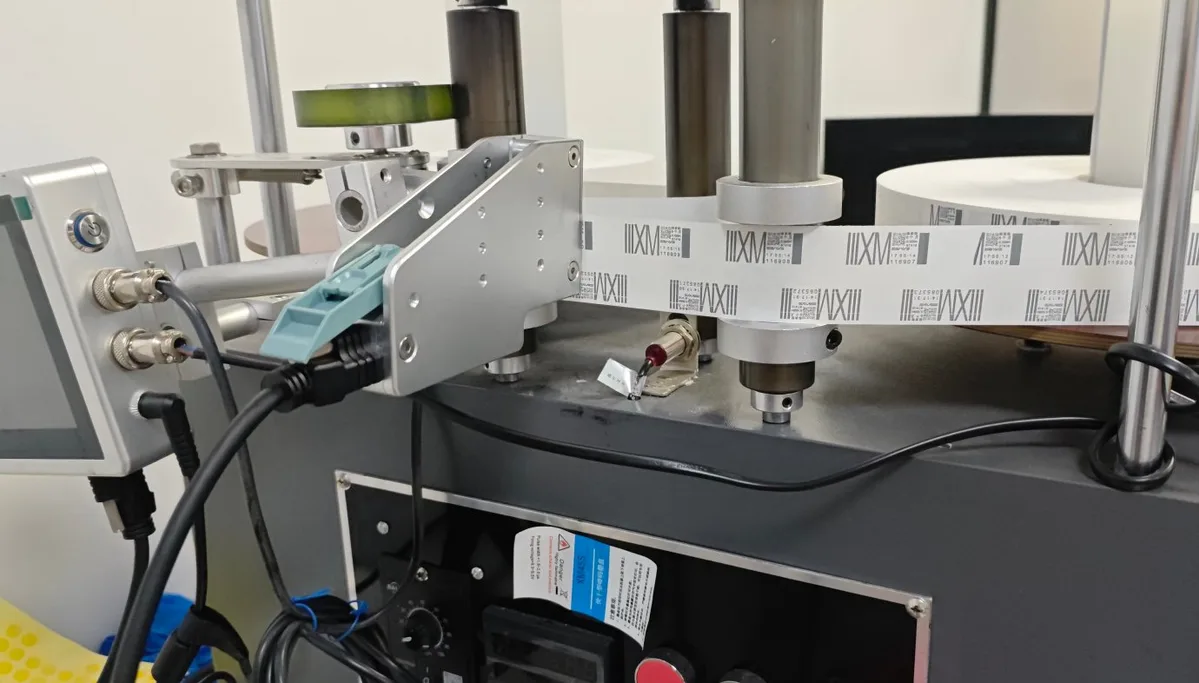
The unit price is not the cost of a printed code
Our solvent TIJ cartridge costs USD 28–58 to buy. That answers the easiest question in this category and the least useful one, because nobody buys cartridges to own them. You buy them to put codes on products, and the cost that reaches your margin is the cost per printed code.
Work it out the same way every time — our XM-45S against another cartridge, or two quotations against each other:
Cost per 1,000 prints = (cartridge price ÷ good prints per cartridge) × 1,000
The price takes ten seconds to check. The prints per cartridge — the denominator — is where every honest comparison is won or lost, and it is the number most listings either invent or leave out. This article shows what moves that denominator, gives you a counted-trial method that produces one you can plan with, and marks clearly the single figure we will not state until it has been measured under stated conditions.
If you are still deciding whether solvent is the right ink family at all, start with What Is a Solvent TIJ Cartridge?. The rest of this page assumes that decision is made and does the costing.
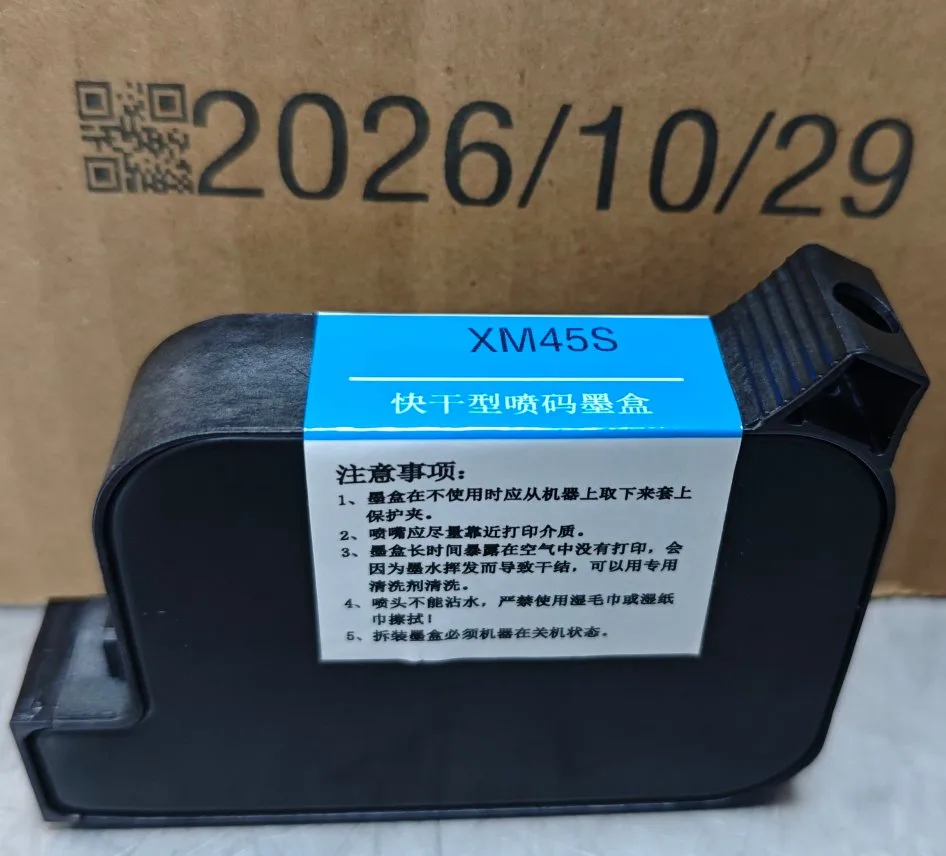
Run the formula before you compare any two prices
Take the two ends of our own published range, because the trap shows up without anyone else’s prices.
A USD 28 cartridge and a USD 58 cartridge differ by USD 30 a unit, and the cheaper one looks like the obvious buy — but only if both deliver the same number of good prints. Divide 58 by 28 and the break-even point appears: the USD 58 cartridge has to deliver about 107% more good prints before its cost per 1,000 prints drops below the cheaper unit’s. Below that ratio the expensive cartridge is expensive twice, at purchase and per code. Above it, the cheap cartridge was the costly one all along.
Do that division on every quotation, including ours. It turns an argument about price into a question about output: not why a cartridge costs more, but how many more good prints it delivers — and measured how. A supplier who answers that with conditions attached, this message and this resolution and this substrate and this speed, is giving you a number you can test. A supplier who answers with a single prints-per-cartridge figure and no conditions is giving you a number you cannot.
The same comparison done line by line across two written offers is worked through in how to compare two TIJ cartridge quotations. Current pricing is on the pricing page and the solvent ink cartridge page. Use those for the numerator. The rest of this article is about the denominator.
Why we will not quote a prints-per-cartridge figure yet
Here is the figure this article needs and does not have, stated plainly instead of filled in:
[TO BE CONFIRMED: good prints per 42ml XM-45S cartridge, by model, message, resolution, substrate and line speed]
Until our factory returns counted results under those conditions, no prints-per-cartridge number appears here as a fact. Apply the same rule to every cartridge you are quoted: 42ml of ink does not convert into a print count on its own, because each variable below changes how much ink leaves the cartridge for one good code — and they multiply rather than add.
| Variable | Low-ink end | High-ink end |
|---|---|---|
| Message content | One line: date only | Several lines plus logo |
| Machine-readable code | None | QR or Data Matrix in every print |
| Character height | Small, compact lines | Tall characters, one-inch band |
| Resolution mode | 300dpi | 600dpi |
| Print height model | 12.7mm (XM-45S-127) | 25.4mm (XM-45S-254) |
| Line behaviour | Continuous running | Stop-start, purges at restart |
Read the table as a spread, not a menu. A single-line date at 300dpi on a continuous line sits at the low end of every row at once. A QR code plus a two-line date at 600dpi on a line that purges after every pause sits at the high end of every row at once. The same 42ml fill serves both jobs, so a figure quoted without its row settings can be out by a multiple — not by a few percent — and a cost plan built on it fails in week one.
Two consequences. When the measured figures arrive they will be published as a set of scenarios, not one headline number, because a headline number would mislead two readers out of three. And your own counted trial outranks any table, ours included: a table tells you which row you are near, a trial tells you your actual denominator.
The scenario table this article will carry once the counts exist
Published in draft form so the factory data has an exact home — and so you can see precisely which conditions we treat as part of the number.
| Scenario | Model and message | Mode | Prints per 42ml cartridge |
|---|---|---|---|
| Single-line date code | XM-45S-127; date + batch, one line | 300dpi | [to be confirmed] |
| Two-line code on carton/cap | XM-45S-127; date + batch, two lines | 300dpi | [to be confirmed] |
| QR code plus date line | XM-45S-254; QR + date in one band | 600dpi | [to be confirmed] |
Substrate and line speed belong in the same table when the data lands — a count taken on PET at one speed is not a count for film at another. Each figure will be a range rather than a point, because hall temperature, pause pattern and operator purge habits move the real result around any laboratory figure. If your job does not match a row, do not interpolate and hope: run the counted trial below, which takes one cartridge and part of one shift.
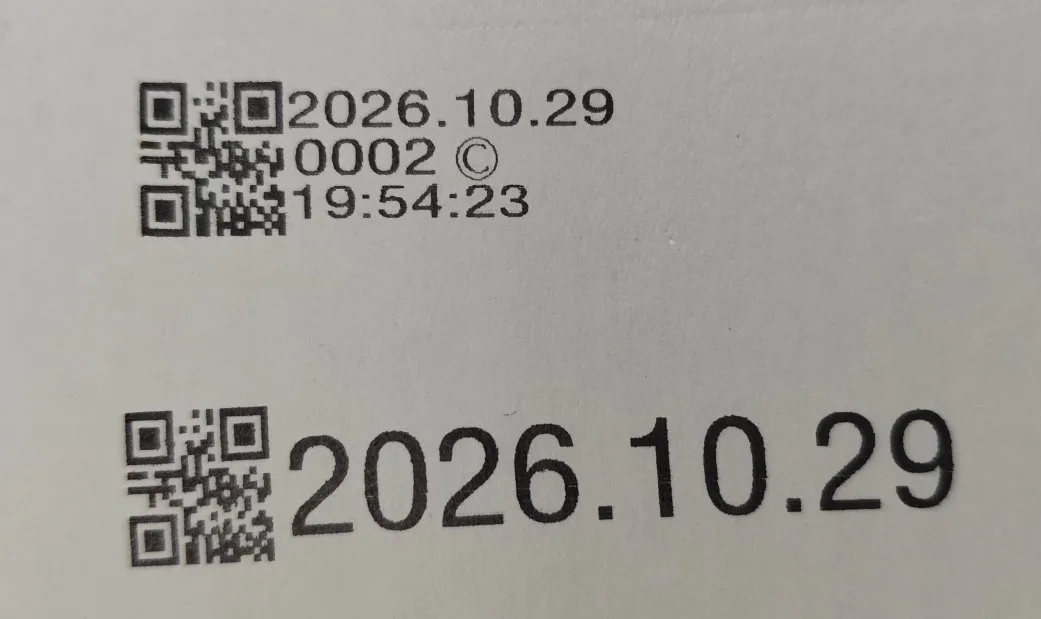
The costs that never appear on a quotation
Cost per 1,000 prints, calculated from a trial count of good prints, already absorbs most hidden costs — that is the point of counting good rather than fired. Naming them separately still helps, because each has an owner on your line who can reduce it.
Purge and idle waste. Solvent evaporates at an idle nozzle plate. For the XM-45S the published approximation is that the head idles roughly 10–15 minutes on fast-dry solvent before the plate begins to dry, to be confirmed per ink. Stop-start lines therefore spend ink on purges and first-print recovery that never reaches a product. What share of a cartridge that represents is [TO BE CONFIRMED: purge and idle waste share, by line pattern] — but the direction is not in doubt. The more pauses in your shift, the further your real denominator falls below any continuous-running figure. A capping routine at every pause is usually the cheapest saving available, because it costs discipline rather than ink.
Changeover and restart losses. Every cartridge change, message change and restart produces a short run of test prints. On a line that changes messages twice a shift those losses are a line item; on a line running one message for a week they are rounding. Count them in the trial.
Rejects and rework. A code that prints but fails — smeared, incomplete, rejected by the end-of-line scanner — has consumed ink and a product. This is why the formula counts good prints: a cartridge that is cheap per unit and produces a higher reject rate raises cost per 1,000 good prints twice, in wasted ink and wasted product. If adhesion is your failure mode, work through Solvent TIJ Cartridge on Metal, Glass & Plastic before changing cartridges. A surface problem billed as an ink problem is the most expensive misdiagnosis in this category.
Speed and second passes. A cartridge that only reaches the required density at reduced line speed, or needs a second pass for a scannable code, has not saved money whatever its unit price. It has spent line capacity, the scarcest resource in the building. Any trial that slows the line to make a cartridge look good is measuring the wrong thing.
How to run a counted trial that produces a real denominator
One cartridge, part of one shift, a notebook. The method matters more than the equipment.
- Fix the job. Load the exact production message — same lines, same character height, same QR or barcode — on the model you intend to buy, XM-45S-127 or XM-45S-254, at the resolution mode you intend to run.
- Fix the conditions. Your substrate, your line speed, your normal pause pattern. Write all three down with the date and hall temperature; a count without its conditions cannot be compared with anything, including your own next trial.
- Start from a known point. Fit a new, full cartridge, note the start count on the printer counter if it has one, or count packs manually.
- Count good prints only. Count what passes your normal end-of-line check, visual or scanner — not what the printer fired. Set rejects aside and count them separately; the reject count is diagnostic information, not waste to hide.
- Log the interruptions. Note every purge, wipe, pause and cartridge handling, roughly timed. This log is what turns a disappointing count into an explanation.
- Run to empty or to a fixed count, then divide. Insert your good-print count into the formula at the price you would actually pay, and repeat the division for any cartridge you compare, using its trial count on your line rather than a figure from its listing.
Send those six items through the contact page and we will run the division with you and match a sample to your conditions. A supplier who will not work from your trial sheet is asking you to buy on theirs.
What the minimum order does to the maths
Cost per print decides which cartridge to run. The minimum order decides how much cash that decision ties up before the first code is sold.
Our published minimum is 160 cartridges, so one order is a multiplication anyone can check: 160 × USD 28 = USD 4,480 at the bottom of the range, 160 × USD 58 = USD 9,280 at the top. Both before freight or local charges, which depend on destination and are quoted per order.
That arithmetic is the practical argument for the order this cluster recommends: sample first, count the trial, then commit the 160. A wrong cartridge at a good unit price is still USD 4,480–9,280 of stock your line does not want, plus the shelf time it spends ageing while you work through it. A counted trial costs one cartridge and part of a shift.
For private-label supply the process and quantities are on the OEM and ODM page — run the same costing first, because a private label multiplies whatever cost per print you start with. How the cartridges are made and checked before they ship is on the manufacturer page.
A worked example: two cartridges, one PET line, no invented winner
A beverage plant codes PET bottles with a production date and batch number, in long shifts, choosing between its current cartridge and the XM-45S.
Notice what this example does not do: it does not announce how many prints either cartridge delivered. For the XM-45S that figure is exactly the data still marked to be confirmed, and inventing a winner would teach the wrong lesson.
What the plant can do today, with published numbers only, is set up the worksheet. Column one: price actually paid per cartridge. Column two: empty, headed “good prints per cartridge, counted on this line, this message, this speed”. Column three: the formula’s output. It runs one cartridge of each type through the trial method, same message, same week, and fills column two from its own notebook. Only then does column three mean anything — and at that point it decides the order without further argument. That includes the break-even check: if one cartridge costs about 107% more per unit, it must also deliver about 107% more good prints, or the cheaper unit wins on the only cost that matters.
The remaining checks are the practical ones: rub-test the code after drying, confirm it still reads after a night in the cold store, watch the restart prints after the line’s normal pauses. A costing that ignores those optimises the ink and ignores the product.
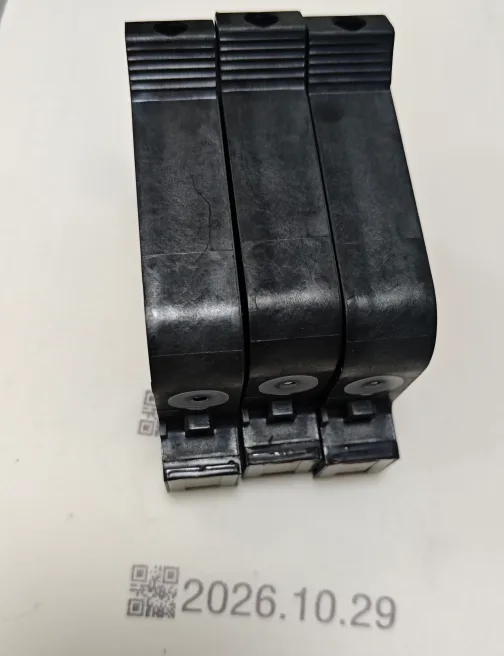
Questions to ask any supplier before costing their cartridge
- Under what conditions was your prints-per-cartridge figure measured? Message, character height, resolution, substrate and speed — all five, or the figure is advertising, not data.
- Is it good prints or fired prints? Only good prints belong in the formula; the gap between the two is your reject rate in disguise.
- Is it a range or a single point? Real lines produce ranges. A single point usually means the best run ever recorded.
- What does it assume about pauses and purges? A continuous-running figure applied to a stop-start line overstates yield by whatever your purge pattern costs.
- Can I count it myself on a sample? The answer to this predicts the value of all the others. Choosing between models on the same platform — drop size, drying and chip as well as price — is covered in HP 2580 vs HP 2590 vs Xinmo XM-45S.
Summary: divide by good prints, or the price is a guess
USD 28–58 is what our cartridge costs to buy, at a minimum of 160, and on its own it cannot tell you whether it is the cheap option or the expensive one for your line. The deciding figure is cost per 1,000 good prints: price divided by good prints counted in a trial under your message, resolution, substrate and speed, times 1,000. Everything above serves that one division.
The figure this page still owes you is the measured yield of a 42ml XM-45S by scenario, and it stays marked to be confirmed until the counts exist under stated conditions. Until then the method is the deliverable: fix the job, count good prints, log the interruptions, divide. A cartridge bought that way rarely turns out to be the expensive one.
Frequently asked questions
How much does a solvent TIJ cartridge cost?
Our XM-45S is published at USD 28–58 per cartridge, with a minimum order of 160 cartridges — USD 4,480–9,280 per order at that range, before freight and local charges. That is the purchase price only. What a printed code costs is a different figure, worked out with the cost per 1,000 prints formula in this article, and it depends on how many good prints a cartridge delivers on your line.
How do I calculate cost per 1,000 prints?
Divide the cartridge price by the number of good prints one cartridge delivers in a counted trial on your own line, then multiply by 1,000. Count good prints — codes that pass your normal end-of-line check — not prints fired, and run the trial with your real message, resolution, substrate and speed, because each of those moves the result.
How many prints does a 42ml solvent TIJ cartridge produce?
We do not publish a figure yet, because a print count is only meaningful with its conditions: the model (XM-45S-127 or XM-45S-254), the message and character height, whether a QR code is included, the resolution mode, and the substrate and line speed. A single-line date code and a QR code with a date line draw very different amounts of ink from the same 42ml. Counted factory results by scenario will be added to this page when they are available; until then, a counted trial on your own line is the reliable route, and any supplier’s unconditional figure should be treated as advertising.
Why can a cheaper cartridge cost more per print?
Because the formula divides by output. A lower-priced cartridge can deliver fewer good prints — through lower yield on your message, more purges on a stop-start line, a higher reject rate, or a slower line speed to reach density. It can then end with a higher cost per 1,000 good prints than a cartridge costing more per unit. At our published range ends, a USD 58 cartridge needs about 107% more good prints than a USD 28 cartridge to break even; run that division on every quotation.
Does printing at 600dpi cost more per print than 300dpi?
Expect the ink per print to rise when a denser, higher-resolution mode lays down more ink for the same message. Expect the size of the rise to depend on the message itself: a dense QR code and a single date line do not scale the same way. How large the difference is on the XM-45S under stated conditions is part of the counted data still to be confirmed; measure it in your trial by running the same message in both modes rather than assuming a percentage.
What hidden costs should I include besides the cartridge price?
Purge and idle waste on stop-start lines, changeover and restart test prints, rejected products and rework, and any line speed or second pass a cartridge forces on you. Counting good prints in a trial absorbs most of these into one honest denominator; the one to manage separately is purge waste, where a capping routine at every pause usually recovers more than any price negotiation.
Related reading
- 30 October 2026
How Solvent TIJ Cartridges Are Made: Inside a Manufacturer's Line
A solvent TIJ cartridge is not bought parts relabelled. It is ink formulated and filtered, a body prepared and…
- 28 October 2026
HP 2580 vs 2590 vs XM-45S: Which Solvent TIJ Cartridge Fits Your Line?
The number on the label decides three separate things — ink behaviour, chip and print height — and they do not…
- 27 October 2026
Solvent TIJ Cartridge on Metal, Glass & Plastic: Adhesion Guide
Adhesion on metal, glass, PET and PE/PP film fails for five different reasons, and the cartridge is rarely the…
Want this confirmed on your own material?
We print on samples of your actual substrate and send them to you. Send the material, the line speed and the code content, and we will tell you honestly whether the fault is the ink, the surface or the line layout.