
Technical Notes
How to Choose a TIJ Ink Cartridge for Plastic Packaging
A cartridge that prints a crisp date code on a carton can smear on a plastic pouch. Here is a sequence that works backward from the finished pack: name the exact print surface, measure the time available before the code is touched, and trial candidates on the line you actually run.
A TIJ cartridge prints a crisp date code on your cartons. Then the same printer moves to a plastic pouch, and the code smears against a guide roller. Is the cartridge defective, or is the ink wrong for the package?
For a packaging plant, that distinction matters. “Plastic” might mean a PE bag, a BOPP snack wrapper, a PET bottle or a coated label, and each one presents a different printing surface. A code can look sharp as it leaves the printhead and still fail when the pack is rubbed, sealed, conveyed or scanned. Replacing cartridges will not fix a mismatch between ink, surface and production conditions.
The practical way to choose is to work backward from the finished package: identify the exact surface being printed, measure how long the ink has before anything touches it, and test whether the code survives the handling it will actually face. A cartridge that passes those checks, and runs reliably in your printer, is worth more than one advertised simply as “fast-drying ink for plastic.”
Match the ink to the actual printing surface
Choose an ink against the specific face of the finished package, not the material name on a purchasing sheet.
Think of printing on plastic like painting a slick door. The paint first has to spread across the surface, then it has to stay there. Drying quickly helps, but it does not prove the bond will survive rubbing. Solvent-based TIJ formulations exist for non-porous packaging, including certain films and plastics, but a stated substrate list is a starting point rather than a guarantee for every formulation of PE, PP or PET.
Two pouches both described as “BOPP film” may arrive with different coatings or surface treatments. Corona treatment raises film surface energy to improve ink wetting and adhesion, so it is worth asking the film supplier which side was treated, and then confirming which face actually receives the code. A dyne test can help diagnose a wetting problem, but it cannot replace a print-and-adhesion trial with the proposed ink. Our substrate matching guide walks through that check face by face for the materials we see most often.
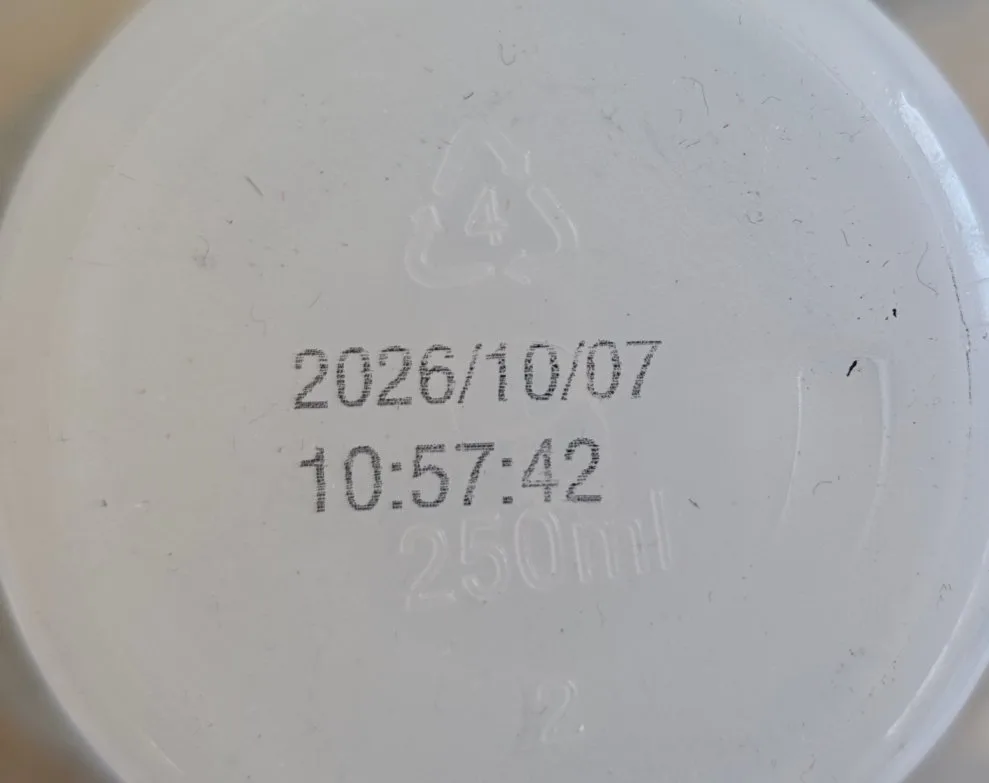
When requesting samples, send finished packs from the production batch rather than a generic sheet of plastic. State whether the code goes onto bare film, a coating or a preprinted area, and whether the package flexes enough for the code to be repeatedly bent. If codes are rubbing off rather than printing badly, that normally points at the surface-ink pair rather than the printer; the diagnostic order we follow for adhesion failures separates the two before you commit to a purchase.
Test drying against the next point of contact
The useful drying time is the time available on your line, before the fresh code touches a roller, belt, stacking surface or another pack.
A supplier’s “fast dry” description is a little like a car’s official fuel-economy figure: useful for narrowing the field, but your operating conditions decide the result. Formulations positioned for flexible film do exist in this solvent category, and packaging-ink guidance generally notes that fast drying helps prevent ink transfer onto rollers. That does not mean every ink in the category will clear your particular roller spacing.
Suppose a snack wrapper reaches a guide roller almost immediately after coding. Print candidates at normal line speed, then inspect the roller and the next several packs for transferred ink. Repeat after a short production stop: the first prints after idle matter as much as the ones made during steady running. Record smearing, missing characters and nozzle recovery as three separate things — an ink can dry perfectly well on the pack and still be inconvenient if it needs attention after every interruption.
Do not compensate for slow drying by reducing line speed unless that is an acceptable production decision. Check print location, contact path and candidate ink first. Contact path is partly a machine question: how quickly the fresh code meets a roller depends on head placement and web routing, which is why the same ink can pass on one machine and fail on the next. Then ask for cartridge-level detail, because it decides how the trial actually runs — printer compatibility, nominal ink volume, storage conditions, nozzle-care procedure. We list those for our solvent cartridges for non-porous surfaces, and they are worth demanding from any supplier you compare.
Approve the code, not just the cartridge
A successful trial ends with a durable, readable code at an acceptable cost per usable pack.
Start from the customer’s actual acceptance requirement. A date code has to stay legible after normal handling; a barcode also has to keep enough contrast and print quality for its intended scanner. If you print a GS1 DataMatrix code, visual inspection alone is not a substitute for verification by the applicable method: GS1 describes contrast as the difference between light and dark areas as the scanner sees them, and points to ISO/IEC 15415 for DataMatrix print-quality testing.
Run a short trial on filled or production-equivalent packs, at normal settings. Inspect samples immediately, again after drying, and once more after the rubbing, flexing or packing steps they will meet. Keep print resolution and message size identical across candidates so the comparison is fair. Track cartridge consumption, cleaning interruptions and rejected packs alongside the purchase price — the cheapest cartridge is not the cheapest choice if it creates rework.
For food packaging, add a separate suitability check. Printing on the outside of a pack does not by itself establish that an ink suits the finished food-contact application: transfer can occur through set-off when materials are stacked or wound. Obtain the relevant ink documentation and have the completed packaging structure assessed against the destination market’s requirements. European Commission guidance on food-contact materials is the usual starting reference for the EU.
An illustrative pouch-line trial
A small snack producer codes batch numbers on the outside of flexible pouches. Its existing cartridge prints cleanly on cartons, but codes on the pouches mark a downstream roller. The operator initially suspects a worn printhead.
The team collects pouches from the current film batch and tests two printer-compatible TIJ inks intended for non-porous surfaces. It prints at normal speed, checks the roller for transfer, rubs fully dried samples, and repeats the run after a planned stop. One candidate leaves less transfer but produces incomplete first codes after idle; the other clears the roller and restarts cleanly. The team approves the second only after confirming legibility on packed samples and reviewing its consumption and handling requirements.
This is an illustrative procedure, not a reported customer result. The transferable lesson is to test adhesion, contact time and restart behaviour together. If both inks fail, the next thing to investigate is the pouch’s print surface and the line layout, not another round of cartridge swapping.
Choose for the finished pack
A TIJ cartridge for plastic packaging is not selected by the word “plastic” on its label. First identify the exact surface and ask for a compatible ink shortlist. Then test every candidate against the time available before contact, the handling the finished pack will undergo, and the readability your customer requires. Finally, include stoppages and rejects when comparing cost. That sequence turns a vague claim of “good adhesion” into a repeatable purchasing decision.
When the surface itself turns out to be the constraint, the work stops being about cartridges at all, which is the same conclusion we reached on PE and PP film. When you talk to us about samples, send the actual package, printer model, code artwork and line conditions together; those details are what make a meaningful cartridge trial possible. You can reach us here with the pack in hand and we will tell you honestly whether the problem is the ink, the surface, or neither.
For the moulded and extruded parts behind the code, coding on HDPE and PP picks up where this leaves off, and see how our TIJ ink cartridge factory is run covers how the 42 ml cartridges are filled and checked.
Related reading
- 30 October 2026
How Solvent TIJ Cartridges Are Made: Inside a Manufacturer's Line
A solvent TIJ cartridge is not bought parts relabelled. It is ink formulated and filtered, a body prepared and…
- 29 October 2026
How Much Does a Solvent TIJ Cartridge Really Cost? Cost per 1,000 Prints
USD 28–58 buys a solvent TIJ cartridge, and that number decides nothing. What reaches your margin is the cost …
- 28 October 2026
HP 2580 vs 2590 vs XM-45S: Which Solvent TIJ Cartridge Fits Your Line?
The number on the label decides three separate things — ink behaviour, chip and print height — and they do not…
Want this confirmed on your own material?
We print on samples of your actual substrate and send them to you. Send the material, the line speed and the code content, and we will tell you honestly whether the fault is the ink, the surface or the line layout.