
Technical Notes
The Code Rubs Off: A Diagnostic Order for Adhesion Failures
When a printed code smears, rubs off or fails a tape test, the cause is one of four things. Working through them in the right order saves you from replacing cartridges that were never the problem. This is the sequence we use when a customer sends us a failed sample.
Start with the drying budget, not the ink
A code starts smearing on a line that was fine last month. The reflex is to blame the ink and order a different cartridge.
That is the last thing to change, not the first. Three other causes produce an identical symptom, and only one of them is the ink. Working through them in order is cheaper, faster, and stops you replacing cartridges that were never the problem.
Work through these four in order. Each one is cheaper and faster to check than the next, and each one rules out a category of cause.
Step 1: Measure the drying budget in seconds
The drying budget is the time between the printhead and the first thing that touches the code, and it is a property of your line layout rather than your ink:
drying budget (s) = distance from printhead to first contact (m) ÷ line speed (m/s)Measure the physical distance. Divide by the speed you are actually running, not the rated speed of the machine. If the answer is under a few seconds on a non-porous surface, the code is being touched while it is still wet, and no cartridge change will fix that.
The usual remedies are layout changes: moving the printhead earlier in the line, adding air movement across the mark, or re-routing the product so the first roller does not cross the code. These are unglamorous and they work.
Step 2: Compare dry-to-touch against fully cured
A code can be dry to the touch and still not be cured. Solvent and water-based inks both go through an initial flash-off followed by a slower cure, and a code wiped in the window between the two will come off even though it looked set a second earlier.
The test is simple: print a sample, wait the full cure time, then rub it. If it passes after curing and fails before, the problem is the line layout allowing contact too early — back to step 1.
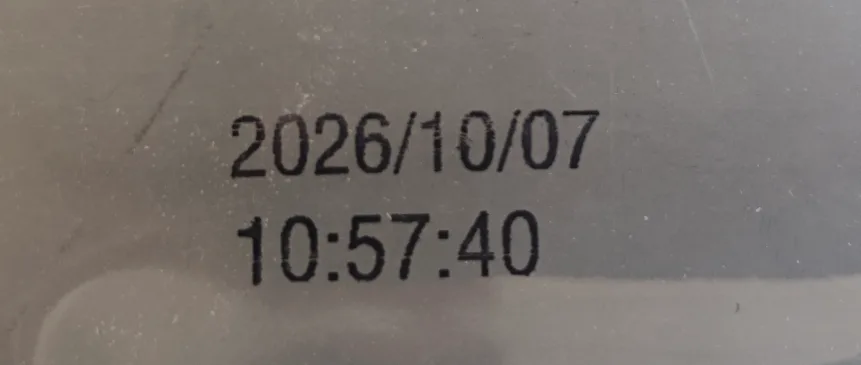
The three photographs below are the same code on the same surface, taken through a standard tape test. The gradient — intact, then breaking up at the edges, then largely gone — is what a drying-budget problem looks like once you take the ink question out of the picture.
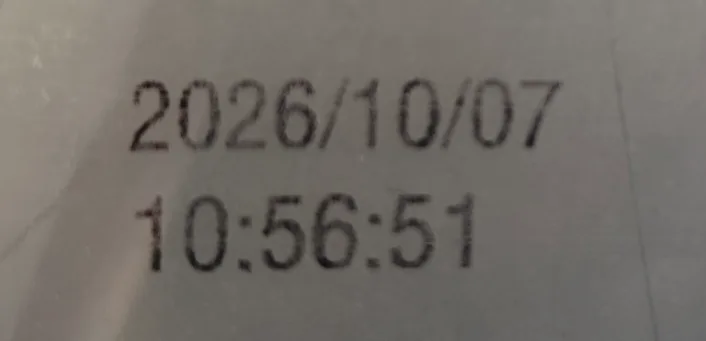
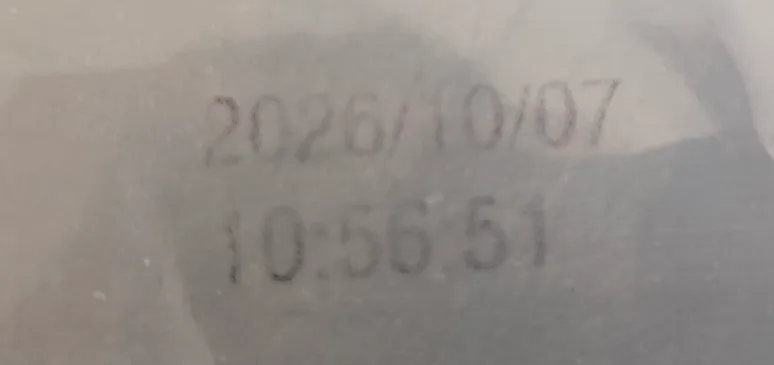
This is also where a supplier who quotes a single drying time in seconds is doing you a disservice. The number that matters is specific to your ink load, your ambient conditions and your cure window.
Step 3: Check the surface energy of the substrate
If the budget is adequate and the code is fully cured and it still comes off, the surface is the likely cause. A liquid wets a solid only when the solid’s surface energy exceeds the liquid’s surface tension with a working margin — commonly quoted as roughly 8 to 10 mN/m.
Untreated polyolefins sit below the surface tension of most coding inks. Untreated PP measures around 26–28 mN/m and HDPE around 28–32 mN/m, against a water-based coding ink at 30–45 mN/m. In that situation the ink is not failing to adhere — it is failing to wet, and it beads up into a mark that sits on the surface and lifts off.
The fix is pretreatment, not a different ink: corona or flame treatment oxidises the surface layer and lifts HDPE to roughly 38–42 mN/m and PP to 40–44 mN/m. This is the single most common root cause in the failed samples we receive, and it is diagnosable before ordering anything. When the surface turns out to be sound and the code still fails, the adhesion guide by substrate works that case through surface by surface.
One caveat worth knowing: corona treatment decays during storage. Stock that was treated and then sat in a warehouse for months can behave differently from a freshly treated sample, which is why a test that passed last quarter can fail this one. If the failure is tied to a change in the ink rather than the surface, the UV security ink is a useful contrast case: it is verified under a lamp rather than by eye, so a wetting problem shows up as a weak signal instead of an invisible code.
Step 4: Only now consider the ink system
If the budget is adequate, the cure is complete and the surface energy is above the threshold, then the ink is worth examining. The relevant question is whether the ink class matches the surface: a water-based ink on a low-energy plastic is the wrong tool regardless of its quality, and the answer is a solvent system formulated for low-energy surfaces rather than a better water-based one.
What to send us when you are stuck
If the four steps have not resolved it, send a printed sample on the actual substrate, plus the line speed and the distance from printhead to first contact. A physical sample tells us more than a description ever will, because we can run the tape and rub tests against it and see the failure mode rather than infer it.
We would rather tell you that your line layout needs to change than sell you a cartridge that will not help. That is a slower conversation on the first enquiry and a much faster one on the second.
When the cause turns out to be the cartridge itself, see how our TIJ ink cartridge factory is run covers the build, fill and test steps the 42 ml units go through.
Related reading
- 30 October 2026
How Solvent TIJ Cartridges Are Made: Inside a Manufacturer's Line
A solvent TIJ cartridge is not bought parts relabelled. It is ink formulated and filtered, a body prepared and…
- 29 October 2026
How Much Does a Solvent TIJ Cartridge Really Cost? Cost per 1,000 Prints
USD 28–58 buys a solvent TIJ cartridge, and that number decides nothing. What reaches your margin is the cost …
- 28 October 2026
HP 2580 vs 2590 vs XM-45S: Which Solvent TIJ Cartridge Fits Your Line?
The number on the label decides three separate things — ink behaviour, chip and print height — and they do not…
Want this confirmed on your own material?
We print on samples of your actual substrate and send them to you. Send the material, the line speed and the code content, and we will tell you honestly whether the fault is the ink, the surface or the line layout.